
Aluminum gate: which type is right for your property?
Picking the wrong gate style is one of the more avoidable mistakes in a fencing project. An aluminum gate that swings into a tight driveway, or a single panel stretched across a 14-foot opening, creates problems you’ll be managing for years. The decision is not complicated once you understand what each configuration is built for.
Aluminum gates come in three configurations: single swing, double swing, and sliding. This guide covers how they differ, what to look for when buying in Canada, and realistic cost ranges.
What types of aluminum gates are available?
The three main configurations are single swing, double swing (bi-parting), and sliding. Single swing suits openings up to about 6 feet. Double swing handles driveway openings from roughly 10 to 20 feet. Sliding gates work where terrain, a slope, or adjacent structures leave no room for a swinging arc.
Single swing gates
A single swing gate hinges on one side and opens inward or outward. It is the standard choice for pedestrian entries, side yard openings, and pool gate access. For anything up to 5 or 6 feet wide, it has the fewest moving parts and the lowest hardware cost.
Paired with a matching aluminum privacy fence, a single swing gate closes the perimeter without visible hardware gaps or mismatched finishes. The whole line reads as one system.
Double swing gates
A double swing gate splits into two panels that open from the center, each hinged to its own post. This is the standard for residential driveways, which in Canada typically span 10 to 16 feet. Each panel carries half the structural load, so hinges and posts wear more evenly over time than they would with a single large panel.
Aluminum alloys are inherently corrosion-resistant, forming a stable oxide layer that protects the metal without a protective coating, and the Aluminum Association notes that some aluminum building products see service lives of 70-plus years. That durability is one of the main reasons aluminum has largely replaced wood in residential gate applications across the country.
For driveway gates combined with a fence along the property line, a semi-privacy aluminum fence is a common pairing. It defines the boundary while keeping some visual openness at grade.
Sliding gates
Sliding gates roll horizontally on a track instead of swinging. They are the right choice when there is a grade change near the opening, when vehicles park close to where the gate needs to sit, or when the driveway approach leaves no swing arc. Common in commercial properties, and increasingly used in residential driveways where setback is tight.
The tradeoff: a sliding gate needs roughly 1.5 times the opening width as clear travel space on one side. A 12-foot driveway opening requires about 18 feet of unobstructed run. If that clearance is not there, a double swing will perform better on your specific property.
Aluminum gate vs. wood vs. steel: how do they compare?
Aluminum is lighter than steel and more dimensionally stable than wood in Canadian freeze-thaw cycles. A typical aluminum gate panel weighs roughly one-third of a comparable steel panel and about half the weight of wood, which affects hinge loading, post sizing, and how long the hardware holds up (Aluminum Association, 2022).
| Feature | Aluminum | Wood | Steel |
|---|---|---|---|
| Lifespan | 25+ years | 8-12 years structural | 15-20 years (maintained) |
| Maintenance | None | Stain every 2-3 years | Repaint to prevent rust |
| Weight | Light (easy on hinges) | Heavy (stresses hardware) | Very heavy (needs large posts) |
| Canadian climate performance | Excellent: no rust, no rot, no warping | Poor: warps and rots in freeze-thaw cycles | Moderate: rusts at welds and hardware contact points |
| Fire classification | ASTM E84 Class A capable | Not rated | Not rated |
| Appearance over time | Holds color and finish | Greys and cracks within 2 seasons | Rust streaks at hinges over time |
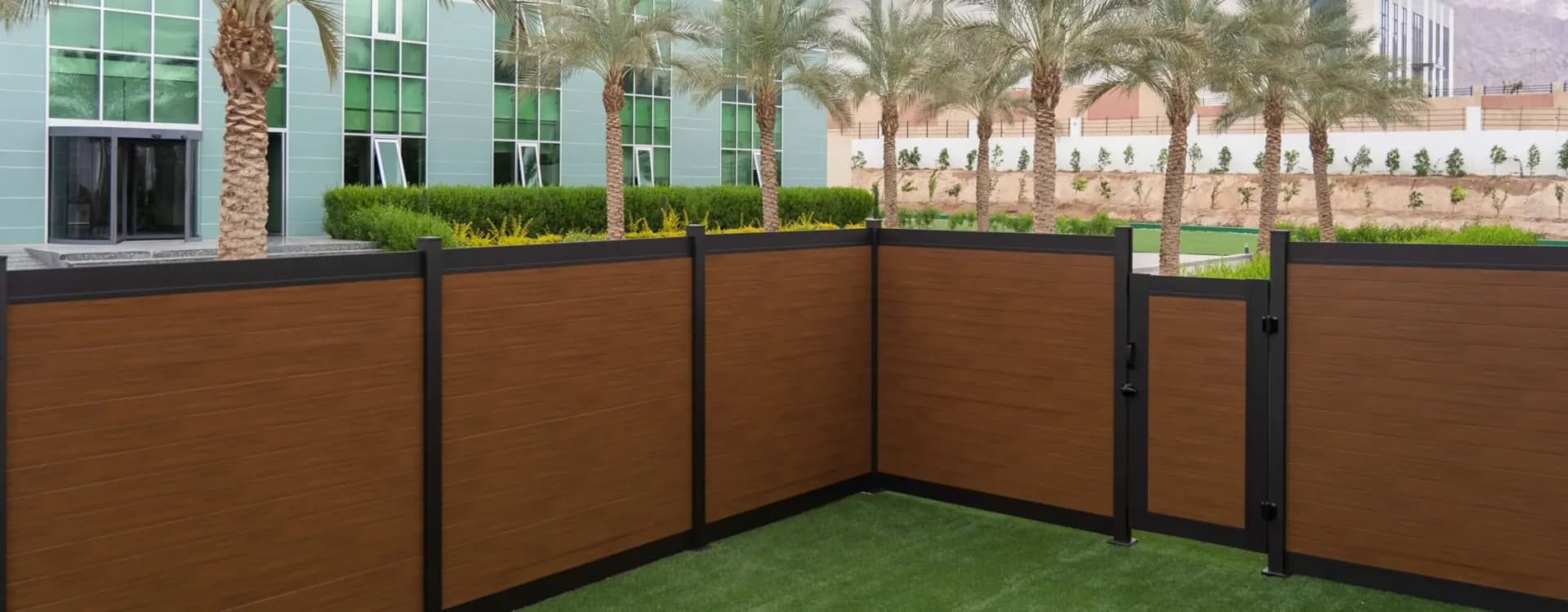
Wood gate failures in Canada come down to the same two problems almost every time: posts that have rotted or heaved below grade, and hardware that binds because the wood moved. The gate itself may look intact while the post it is hanging from has shifted enough to throw off the whole swing. Aluminum removes both failure points. There is nothing to rot underground and nothing to swell when it gets wet.
The PrimeAlux aluminum gate system uses the same three-layer wood-grain coating as the fence panels. Available colors are Natural Walnut, Grey Walnut, Walnut, Dark Walnut, and Grey Brown. Gate and fence finish from the same system, so nothing mismatches.
How do you choose the right aluminum gate size?
Gate sizing depends on the clear opening width (measured post to post, not including post diameter), the intended traffic, and fence height. Measure the opening before ordering. Gates are typically sized slightly narrower than the raw opening to allow 1-2 cm on each side for hinge and latch clearance.
Standard width ranges by application
- Pedestrian or side yard entry: 3 to 4 feet (single swing)
- Pool compliance minimum: 36 inches in most provinces, self-closing required (verify with your local building department)
- Single-vehicle driveway: 10 to 12 feet (double swing or sliding)
- Double-vehicle driveway: 14 to 20 feet (double swing or sliding)
Gate height
Match gate height to fence height for a clean perimeter line. PrimeAlux aluminum gates are available from 4 to 8 feet in the same panel profiles as the fence system. Custom sizing is available for non-standard configurations.
Pool enclosures have specific requirements under provincial building codes and the National Building Code of Canada. The gate must open away from the pool, close automatically, and latch automatically with the latch at 1.5 metres or higher, or key-operated on the pool side. Requirements vary by province. Confirm with your local building department before ordering. The PrimeAlux gate page covers pool compliance details.
Manual vs. automated aluminum gates: what is actually worth it?
For most residential applications, a manual gate is the right choice. Automation adds $1,500 to $5,000 or more to total project cost, requires a licensed electrician, and needs periodic maintenance on the motor and control board. A well-designed manual latch on a properly sized aluminum panel handles daily use reliably without any of that overhead.
Automation makes sense in two situations: a driveway gate you open many times per day from inside a vehicle, and a wide opening that is awkward or genuinely heavy to push manually. Both are real use cases. They are just not universal ones.
Gate operator types
Swing operators attach to the post or hinge point and push or pull the panel. They work on level ground and most residential models handle openings up to 16 feet. Slide operators motor along a rack at the base of the panel, which makes them the better option on sloped driveways where swing clearance is limited.
Aluminum’s weight advantage is meaningful for automation. A lighter panel needs a smaller motor, which wears less over time. The basic engineering rule is to select an operator matched to the manufacturer’s rated gate weight, size, and duty cycle — a lighter aluminum panel makes that rating easier to meet with a smaller, less strained motor than a comparable steel or wood gate would need.
For sizing and automation compatibility on specific panels, the PrimeAlux aluminum gate system supports both swing and slide operators depending on opening configuration.
What should you check before buying an aluminum gate in Canada?
The price difference between suppliers often reflects real differences in how the product is built. A few things worth verifying:
Ask for the alloy specification. The grade affects weld quality, joint strength, and dimensional stability over years of use. A supplier that cannot or will not provide this information is not a supplier you should be buying from.
Check the coating system. A single powder coat performs adequately in mild conditions, but Canada’s freeze-thaw cycles are hard on coatings. A three-layer system (primer, base coat, topcoat) is more durable. PrimeAlux uses a three-layer process across all fence and gate products, the same coating applied to the Privacy Plus fence panel line.
Confirm post sizing for the gate load. The gate post carries the full panel weight plus wind load at the hinge point. For openings wider than 6 feet, post sizing needs to account for the increased load. Undersized posts are one of the more common installation problems that show up a year or two after the job is done.
Ask for wind test data, not just a wind rating claim. PrimeAlux fence and gate systems are wind-load tested to 220 km/h. That number is backed by published test data. A claim of “wind resistant” with nothing behind it is not a specification. It is a marketing phrase. You can review PrimeAlux’s fire and structural test data at primealux.ca/astm-e84-fire-test/.
PrimeAlux products also carry an ASTM E84 Class A fire rating, with a Flame Spread Index of 0 and Smoke Developed Index of 50. This is a verified test result.
How much does an aluminum gate cost in Canada?
Residential aluminum gates typically cost $400 to $900 for a pedestrian-width single swing panel, and $900 to $2,500 or more for a double swing driveway configuration, before installation. Installed costs depend on post requirements, grade prep, hardware selection, and whether automation is part of the project.
A wood gate at the same width usually runs $150 to $400 in materials. That gap closes faster than most homeowners expect. Hardware replacement, repainting or restaining every 2-3 years, and the probability of a full replacement within 10 years as the wood shifts all add up. Over a 20-year horizon, the total cost of ownership for wood often matches or exceeds aluminum.
The full fence perimeter typically runs $80 to $120 per linear foot installed for residential aluminum privacy fence systems in Canada. Gates are priced separately.
For project-specific pricing on aluminum gates, contact PrimeAlux directly. Panel size, post requirements, and hardware selection vary enough that a project quote is more useful than a range.
Frequently asked questions about aluminum gates
What is the most common aluminum gate type for residential driveways in Canada?
Double swing gates are the most common for residential driveways. They handle openings from 10 to 20-plus feet, split panel weight across two hinge sets, and leave no ground track to fill with snow and ice. Sliding gates are a good alternative when driveway geometry limits swing clearance, but require 1.5 times the opening width in clear run space to one side.
How deep should gate posts be set?
Gate posts for aluminum gates should be buried at least 3 feet below grade in Canada, deeper in areas with significant frost penetration. Frost heave is the primary cause of post movement and gate misalignment over time. Set posts in concrete, allow the concrete to cure fully before hanging the gate, and confirm post sizing matches the panel load.
Can aluminum gates be automated?
Yes. Aluminum’s light weight makes it well-suited to automation. Lighter panels require smaller motors and put less mechanical strain on the operator over time. Both swing-arm and slide-rack operators work with aluminum gate systems. Automation typically adds $1,500 to $5,000 or more to total project cost depending on operator type and opening width. A licensed electrician is required for the power connection.
Do aluminum gates rust?
No. Aluminum does not rust. It forms a natural oxide layer when exposed to air that prevents further corrosion. The three-layer coating on PrimeAlux gates adds UV and scratch resistance on top of that. This makes aluminum well-suited to Canadian coastal environments, high-humidity conditions, and properties near roads treated with road salt in winter.
What are the pool gate requirements in Canada?
Pool enclosure gates must open away from the pool, close and latch automatically, and have the latch positioned at 1.5 metres or higher, or key-operated on the pool side. Minimum gate height is typically 1.2 metres. Requirements vary by province and municipality, so confirm specifics with your local building department before ordering. Do not rely on what a neighbor’s contractor installed; code requirements change and vary by location.
How long do aluminum gates last?
Aluminum gates typically last 25 years or more without material degradation. Unlike wood, which warps and rots, or steel, which corrodes at weld points and hardware contact, aluminum holds its shape and finish across freeze-thaw cycles without maintenance. The hardware will wear before the gate panels will, which is why post quality and hinge grade matter more than most buyers realize at the time of purchase.
What colors are available for PrimeAlux aluminum gates?
PrimeAlux aluminum gates come in five wood-grain finishes: Natural Walnut, Grey Walnut, Walnut, Dark Walnut, and Grey Brown. All use a three-layer coating process. Gates are finished in the same palette as the fence panels, so the complete perimeter matches rather than having the gate stand out as a different product.
Is a permit required to install an aluminum gate in Canada?
It depends on your municipality, gate height, and property type. Pool enclosure gates almost always require a permit and inspection. Front yard gates above a certain height (often 1 metre or 1.2 metres) also typically require one. Check with your local building office before starting. The cost and time involved in a permit is minor compared to the cost of undoing work that fails inspection.
Getting the right gate before installation
The gate type decision matters more than it looks like it should. A double swing with no swing clearance, or a sliding gate on a lot without run space, creates real problems after the fact. Get the configuration right for your property first, measure the opening carefully before ordering, and match the gate height to your fence.
Aluminum is the right material for this. It is lighter than steel, more stable than wood, and requires no treatment to hold its appearance year over year. A gate installed with proper post depth and correct hardware works the same in year 20 as it does in year one.
Explore PrimeAlux aluminum gates for available sizes, panel profiles, and finish options. For project-specific sizing and pricing, contact PrimeAlux directly.
