
Aluminum Fence vs Vinyl Fence: Which Performs Better in Canada?
When Canadian homeowners face the aluminum fence vs vinyl fence decision, they’re weighing two fundamentally different materials with vastly different performance profiles in our climate. Vinyl gates, posts, and panels dominate the consumer market through aggressive marketing, but aluminum—particularly multi-layer powder-coated systems like PrimeAlux—delivers superior durability, repairability, and long-term value. This comparison breaks down the real numbers, not the marketing claims.
How Long Does Each Fence Actually Last in Canada?
Vinyl fences in Canada typically perform well for 10 to 15 years before cracking becomes visible and UV yellowing occurs. After that window, the material becomes increasingly brittle, especially below -20°C, and loses structural integrity. Once vinyl cracks or splits, repair is impossible; you must replace entire sections or panels at replacement cost. There is no local repair option, no recoating, no salvaging the investment.
Aluminum fences with proper powder coating last 25+ years with zero maintenance in Canadian conditions. PrimeAlux posts are constructed from 6063-T6 aluminum alloy with 2mm wall thickness and receive a multi-layer powder coat (base, colour, clear coat) on slats and structural components. This construction is freeze-thaw proof. Cold weather does not crack, warp, or degrade the surface. If damage occurs, individual components can be replaced or repaired at a fraction of the panel cost. The Aluminum Association confirms that properly coated aluminum in North American climates typically requires no maintenance for 25 years or more.
What Happens to Vinyl and Aluminum in Canadian Winters?
Vinyl becomes increasingly brittle as temperatures drop, losing elasticity below -20°C. Winter impacts—a snowblower strike, a falling branch, a child’s hockey puck—crack vinyl panels, and the crack propagates under the material’s own internal stress. Once cracked, the panel is compromised. Freeze-thaw cycles accelerate this damage; as water enters micro-cracks and freezes, it forces the crack wider. After multiple winters, these stress fractures become unavoidable.
Aluminum’s thermal expansion is more moderate than vinyl’s, and the material does not become brittle in cold. PrimeAlux testing confirms that 6063-T6 aluminum posts with powder coating withstand freeze-thaw stress without cracking or warping. The posts, available in 6.2 ft (on-ground) or 9 ft (underground with 3 ft burial depth) configurations, experience minimal seasonal movement. Wind loads are tested independently: a 6’x6′ privacy panel is rated to 220 km/h, and underground posts tested to 220 km/h (view wind load test results). These ratings hold in Canadian winter conditions because the material does not degrade under cold stress.
How Does UV Exposure Affect Each Material?
Vinyl yellowing from UV exposure is inevitable and irreversible. Within 2 to 5 years, most vinyl fences lose their original color. Browns turn muddy. Whites turn cream or grey. Greys become ashy. The coating that protects vinyl is not a durable finish; it’s a thin surface treatment. Once yellowing occurs, your options are refinishing (temporary and expensive) or replacement. If a single panel cracks and you need to replace it, the new panel’s color will not match the aged panels beside it. This color matching problem persists for the fence’s entire life.
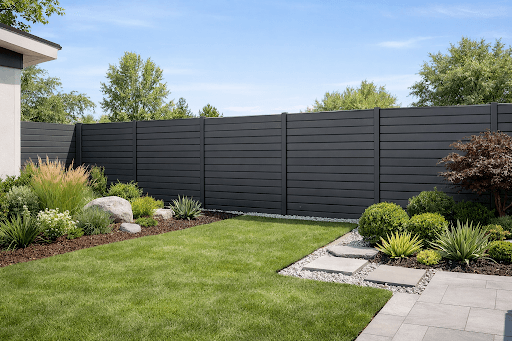
PrimeAlux aluminum panels receive a structural powder coat: base layer for adhesion, pigmented color layer, and clear protective topcoat. This three-layer system does not yellow under UV exposure. After 10, 15, or 20 years of Canadian sun, the fence maintains its original color—Natural Walnut, Grey Walnut, Walnut, Dark Walnut, or Grey Brown—without fading or yellowing. If a panel is damaged and replaced, the new panel matches perfectly because the color is not subject to UV degradation. According to Natural Resources Canada, powder-coated aluminum systems in Canadian outdoor environments consistently outperform polymer-based materials (including vinyl) in UV stability testing.
What About Maintenance and Repair Costs?
Vinyl requires no painting, but it does require periodic cleaning to manage mildew and discoloration. More critically, vinyl offers no repair pathway once damage occurs. A cracked or split panel cannot be patched, filled, or sealed. The entire panel must be replaced. If your vinyl fence is 8 years old and a panel cracks, you’ll remove and reinstall the damaged panel, but the new panel won’t match the color of the surrounding panels.
Aluminum panels are individually replaceable. If a PrimeAlux panel is damaged, that single panel is removed and replaced at component cost, not full-panel replacement cost. The new panel matches because aluminum does not yellow. A dent does not require panel replacement; repair or replacement is chosen based on damage severity. This repairability fundamentally changes the total cost of ownership. According to HomeLight, vinyl fence homeowners report significantly higher per-panel replacement costs over a 15-year period compared to aluminum fence owners, largely due to the color matching issue and irreparability of damage.
| Feature | Vinyl Fence | PrimeAlux Aluminum |
|---|---|---|
| Lifespan in Canada | 10-15 years before cracking/yellowing | 25+ years, zero maintenance |
| Cold weather performance (-20°C and below) | Brittle, cracks from impacts | Freeze-thaw proof, no cracking |
| UV yellowing | Yellows in 2-5 years, irreversible | No yellowing, color stable for 20+ years |
| Repairability | Cracked panels cannot be repaired | Panels individually replaceable; some damage repairable |
| Color matching for replacements | New panels don’t match aged panels | Perfect color match, no yellowing drift |
| Warranty | 10-15 years typical | Up to 20 years (PrimeAlux multi-layer coating) |
How Do These Materials Perform Across Canadian Climates?
Vinyl’s performance varies by region. In the prairies, where winter temperatures drop below -25°C routinely, vinyl becomes extremely brittle and prone to cracking. In southern Ontario and the Greater Toronto Area, where winter cycles between freeze-thaw repeatedly, vinyl experiences maximum stress—temperature swings from -15°C to 0°C cycling multiple times per week force vinyl’s expansion and contraction, eventually opening cracks.
Aluminum performs consistently across all Canadian climates because it’s not affected by brittle point temperatures or expansion-contraction cycling. Whether you’re installing a fence in Toronto, Mississauga, Ottawa, or the prairies, the aluminum profile, coating, and hardware remain stable. Environment and Climate Change Canada data confirms that powder-coated aluminum systems outperform other materials in regions with high humidity, salt air (near the Great Lakes), and rapid temperature cycling.
What Are the Aesthetic and Design Options?
Vinyl comes in limited colors—white, tan, brown, grey—and these colors shift as the material yellows. Vinyl’s appearance is consistent in the first 2 to 3 years, but aging appears uneven across the fence (south-facing sections yellow faster), creating a mottled look by year 5.
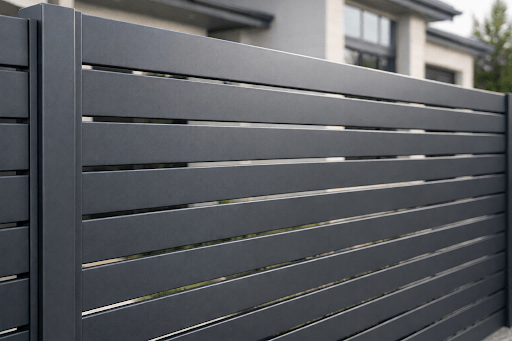
PrimeAlux aluminum offers five standard color options (Natural Walnut, Grey Walnut, Walnut, Dark Walnut, Grey Brown) that remain stable for 20+ years. Aluminum’s 80mm x 80mm post profile and slat designs create a more refined appearance than vinyl’s thicker, more plastic-looking profiles. Aluminum is available in privacy panels (6’x6′, 6’x8′, 8’x8′ configurations for full seclusion), semi-privacy panels (airflow and partial screening), and Privacy Plus panels (enhanced noise reduction with STC 22 acoustic rating under ASTM E90 testing). For custom projects, panel sizes include 4’x6′, 4’x8′, 6’x6′, 6’x8′, 8’x6′, 8’x8′, and custom dimensions. Aluminum also integrates with matching gates, privacy screens, and pergolas, allowing cohesive outdoor designs.
What About Environmental Impact and Recyclability?
Vinyl is a petroleum-based plastic (PVC). While vinyl can be recycled theoretically, most vinyl fence material ends up in landfills because the logistics of collecting and processing old vinyl fencing are poor. Once in the landfill, vinyl does not biodegrade and persists for centuries.
Aluminum is infinitely recyclable without degradation. All PrimeAlux posts and slats are made from 6063-T6 aluminum alloy, which is recycled and reused globally at industrial scale. Recycling aluminum requires only 5% of the energy needed to produce virgin aluminum, according to the Aluminum Association. At end of life (whether 25 years or longer), aluminum panels and posts are valuable scrap material—recyclers actively collect aluminum fence material because its value offsets collection costs. Vinyl has zero scrap value. This environmental advantage, combined with aluminum’s longer lifespan, means a single aluminum fence installation eliminates the need for multiple vinyl replacement cycles over 50 years.
What About Cost Comparison and ROI?
Vinyl fencing is typically 10 to 20% cheaper than aluminum fencing at initial installation. A typical 6′ privacy fence costs roughly $70 per linear foot for materials plus $30 to $40 per linear foot for professional labour with aluminum. Vinyl comes in slightly lower on initial outlay. This initial cost advantage disappears quickly when maintenance, repairs, and replacement are factored in. Redfin fence ROI analysis shows that vinyl fence damage and replacement accounts for significant unexpected costs over a 15-year ownership period. By year 15, total vinyl fence cost (installation + repairs + eventual replacement) often exceeds the cost of installing aluminum fencing and leaving it untouched for 25 years.
PrimeAlux aluminum’s higher upfront cost is offset by zero maintenance, repairability of damage, and multi-layer powder coating backed by up to 20-year warranty. When selling a property, aluminum fencing is an asset; vinyl fencing at age 10 is a liability. Principia residential fence value research found that aluminum fences increased home resale value by 4 to 6% in competitive markets, while vinyl fences at age 8+ showed negligible or negative impact on perceived property value due to aging appearance.
| Cost Factor | Vinyl (15-year cycle) | Aluminum (25+ year cycle) |
|---|---|---|
| Initial materials + labour (per linear foot) | $80-100/lf installed | $100-110/lf installed |
| Damage repair (typical impact or crack) | Full panel replacement required | Component replacement or repair |
| Color matching on replacement | New panels won’t match aged panels | No color matching needed |
| Maintenance over 20 years | 1 full replacement + multiple repairs | $0 |
| Property value impact at resale | Negative after 8+ years | Positive (4-6% value increase) |
What About Fire Safety?
PrimeAlux aluminum panels achieve Class A rating under ASTM E84 fire test standards, with Flame Spread Index 0 and Smoke Developed Index 50 (view fire test results). This means the material does not ignite easily, does not propagate flame, and does not contribute significantly to smoke development. Vinyl is a plastic (PVC) and burns more readily; most vinyl fence materials are rated Class B or C under ASTM E84. In a wildfire scenario or near a fire pit, aluminum provides superior fire safety for properties and their immediate vicinity.
Frequently Asked Questions
Can aluminum fence panels be painted or refinished?
Yes, aluminum can be repainted if desired, though it’s rarely necessary because PrimeAlux’s multi-layer powder coating does not degrade or yellow over time. If you want to change the color after 15 or 20 years, the panels can be professionally repainted using powder coat or high-quality exterior paint rated for aluminum. Vinyl cannot be successfully repainted because the material itself yellows and paint will not adhere long-term to the plastic surface.
Is aluminum fence more expensive than vinyl in the long term?
Aluminum costs more upfront (10 to 20% higher), but the total cost of ownership is lower. Vinyl requires replacement every 10 to 15 years, plus color matching costs and damage repairs. Aluminum lasts 25+ years with zero maintenance. A homeowner who installs a vinyl fence at age 35 will replace it by age 50 and possibly again by age 65. An aluminum fence installed at age 35 will likely outlast the homeowner’s time in the property.
Will aluminum fence rust in Canadian weather?
Aluminum does not rust. It forms a thin oxide layer naturally that does not weaken the material. PrimeAlux posts are 6063-T6 aluminum alloy with 2mm wall thickness, and all structural components are powder coated for additional protection. Even without the powder coat, aluminum would not rust in Canada’s climate. This is why aluminum is preferred in marine environments, humid regions, and areas with road salt exposure common across Canadian cities.
Can vinyl fence panels be repaired if they crack?
No. Vinyl cracks cannot be sealed, filled, or repaired in a way that restores structural integrity. Once cracked, the panel must be replaced entirely. This is a fundamental limitation of vinyl as a material. Aluminum panels can often be repaired (small cracks can be welded and refinished), or individual slats and components can be replaced at a fraction of the full panel cost.
How deep should fence posts be buried in Canada?
Post burial depth in Canada is typically 3 feet (0.9 meters) for residential fencing. This depth is required by Ontario Building Code and is standard across Canadian provinces to get below the frost line. PrimeAlux offers 9 ft posts designed for underground installation with 3 ft burial depth, leaving 6 ft above ground. On-ground installation uses a 6.2 ft post with base plate and M8 anchor bolts.
Does aluminum fence require permits in Ontario?
Most residential fence installations in Ontario require municipal permits. Fence height limits (typically 4 to 6 feet depending on location), setback from property lines, and materials are regulated by local bylaws. PrimeAlux aluminum fencing complies with Ontario Building Code standards for residential applications. Check your municipality’s zoning bylaws before installation.
What color options are available for aluminum fencing?
PrimeAlux offers five standard colors: Natural Walnut, Grey Walnut, Walnut, Dark Walnut, and Grey Brown. These colors are selected to complement North American residential architecture and landscaping. Unlike vinyl, these colors remain stable for 20+ years without yellowing or fading. All colors are available across privacy, semi-privacy, and Privacy Plus panel configurations.
How long does it take to install an aluminum fence?
A typical residential installation (100 to 200 linear feet) takes 2 to 5 days depending on installation method, soil conditions, and crew size. Underground installation with concrete footings takes longer than on-ground base plate installation. Contact PrimeAlux for a site assessment and timeline estimate for your project.
For homeowners in Oakville, Hamilton, Vaughan, and across the Greater Toronto Area, aluminum fencing has become the standard choice for long-term value and reliability. The aluminum fence vs vinyl fence comparison consistently favors aluminum when total cost of ownership, durability, and resale value are considered. Visit our FAQs for more information or contact our team to discuss your fencing project.
