
Aluminum Pool Fence: Requirements, Styles and Best Options in Canada
If you have a backyard pool in Canada, you need a fence around it. That part is not optional. The question is which material holds up best next to chlorinated water, salt splash, and Canadian winters.
Aluminum pool fencing costs vary by project, contact PrimeAlux for a current quote, lasts 25 to 30 years, and never needs painting or staining. In Ontario it meets municipal pool-enclosure bylaw height requirements (1.2 m to 1.8 m depending on your city, see our Ontario pool fence requirements guide) and accepts the self-closing gate hardware that every province demands. Over 20 years, you will spend less on aluminum than on wood or wrought iron once you account for maintenance.
This guide breaks down Canadian pool fence regulations, compares materials side by side, and covers what to look for in panels and gates.
What are the pool fence requirements in Canada?
Canadian pool fence regulations vary by province and municipality, but most follow a similar framework. In Ontario, pool enclosure height is set by municipal bylaw, not a single provincial number: Toronto requires 1.2 metres for single residential properties (1.8 metres for multi-residential and non-residential) under Municipal Code Chapter 447, while Hamilton and Ottawa both require 1.5 metres under their own pool enclosure by-laws. See our Ontario pool fence requirements guide for the full city-by-city breakdown. Every one of these bylaws also requires openings no wider than 100 mm (4 inches) and a self-closing, self-latching gate.
According to the Lifesaving Society of Canada, drowning is the second leading cause of unintentional death for children aged 1 to 4 in Canada. Pool fencing meaningfully reduces unsupervised pool access. These requirements exist because they save lives.
Most Canadian municipalities add their own bylaws on top of provincial codes. Toronto, Ottawa, Mississauga, and Hamilton all require pool enclosures with permits. Some municipalities specify that the fence must be at least 1.2 metres from the pool edge, and many require that the latch on self-closing gates sits at least 1.5 metres above grade or on the pool side of the gate.
Key requirements across most Canadian jurisdictions:
- Minimum fence height: 1.2 m to 1.8 m in Ontario, set by municipal bylaw and varying by city; 1.2 m (4 ft) in some other provinces
- Maximum gap between pickets or slats: 100 mm (4 in)
- Self-closing, self-latching gate hardware required
- Gate must swing outward (away from the pool)
- No climbable horizontal rails in the bottom 1.2 m of the fence
- Fence must completely enclose the pool area
PrimeAlux aluminum fence panels meet these specifications out of the box. The standard 5-foot privacy and semi-privacy panels have no climbable footholds, and the aluminum gate systems accept self-closing hinges and magnetic self-latching hardware.
How much does an aluminum pool fence cost in Canada?
A residential aluminum pool fence costs between $45 and $85 per linear foot installed in Canada, depending on panel style and site conditions. For a typical 60-foot pool perimeter, expect to pay $2,700 to $5,100 for materials and installation combined.
According to the Canadian Home Builders’ Association (CHBA), fencing is one of the top five backyard improvements that recovers its cost at resale. The Appraisal Institute of Canada notes that a well-maintained pool enclosure can add 3% to 5% to a property’s backyard value assessment.
The table below compares installed cost, lifespan, and 20-year total spend for a 60-foot pool perimeter:
| Material | Cost per Linear Foot (Installed) | Lifespan | Annual Maintenance Cost | 20-Year Total (60 ft) |
|---|---|---|---|---|
| Aluminum | $45–$85 | 25–30+ years | $0 | $2,700–$5,100 |
| Wood (Cedar) | $35–$65 | 10–15 years | $150–$300/year (stain, repair) | $5,100–$9,900 |
| Wrought Iron | $60–$120 | 20–25 years | $100–$200/year (rust treatment) | $5,600–$11,200 |
| Vinyl/PVC | $30–$55 | 12–18 years | $0–$50 | $1,800–$3,300 + replacement |
| Glass | $150–$300 | 20+ years | $100–$200/year (cleaning) | $11,000–$22,000 |
| Chain Link | $20–$40 | 15–20 years | $0–$50 | $1,200–$2,400 |
Aluminum sits in the mid-range for upfront cost but wins on total cost of ownership. Wood needs restaining every 2 to 3 years in Canadian climates. Wrought iron rusts when pool chemicals splash on it. Vinyl gets brittle after repeated freeze-thaw cycles, and glass panels require professional cleaning and cost three to five times more.
Why does aluminum work so well around pools?
Aluminum does not rust when exposed to chlorinated water, salt, or the calcium buildup that splashes off pool decks. The Aluminum Association reports that architectural aluminum alloys resist atmospheric corrosion for 40+ years without any surface treatment. That matters around a pool, where everything gets wet constantly.
Pool water contains 1 to 3 ppm of free chlorine, and saltwater pools generate chlorine from dissolved salt. Wood absorbs this moisture and rots from the inside out. Steel and wrought iron pit and flake. Aluminum forms a natural oxide layer that blocks further corrosion, even near salt air. PrimeAlux panels add a powder-coated finish over this oxide layer for double protection.
Then there is the cold. Environment and Climate Change Canada data shows most of Ontario gets 100+ freeze-thaw cycles per year. Wood splits and cracks under this stress. Vinyl becomes brittle below -20°C and can shatter on impact. Aluminum holds its shape across the full Canadian temperature range, from -40°C to +40°C, without warping or cracking.
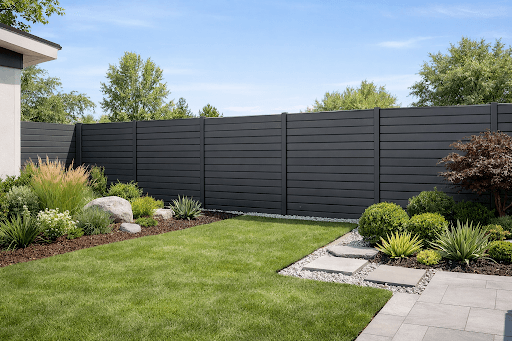
Maintenance is where the real savings show up. Wood fencing around a pool needs restaining every 2 to 3 years. Wrought iron needs rust treatment annually. Aluminum needs a rinse with a garden hose. Over 20 years, that difference adds up to $3,000 to $6,000 in saved maintenance costs versus wood alone.
Pool areas also tend to be open spaces with higher wind exposure. PrimeAlux aluminum panels have been wind-load tested for Canadian conditions, including exposed lakefront and rooftop pool installations.
What pool fence style should you pick?
The right style depends on how much privacy you want and how close your neighbours are. A tight urban lot in Toronto is a different situation from a lakefront property in cottage country.
Privacy panels provide full visual screening and wind protection. They work well for urban pools where neighbours look down from a second storey, or for backyard hot tubs where complete privacy matters. PrimeAlux privacy panels use interlocking aluminum slats with no gaps between them.
Semi-privacy panels balance airflow with screening. The spaced slat design lets breezes through while still blocking most sightlines. This style works well for pools surrounded by gardens or decks where you want air circulation on hot summer days. According to Natural Resources Canada, proper airflow around pool decks reduces surface moisture and extends the life of adjacent deck materials.
Horizontal slat designs are the fastest-growing fence style in residential Canada. The clean, modern look pairs well with contemporary pool designs, and horizontal slats meet code requirements as long as the gaps are under 100 mm and there are no climbable footholds below 1.2 m.
One thing to keep in mind: ornamental picket-style fences are common for pool enclosures in the U.S., but many Canadian municipalities prefer solid or semi-solid barriers because they also block wind-blown debris and provide privacy. Check your local bylaw before choosing between picket and panel styles.
What gate hardware do pool fences need?
Pool fence gates in Canada must be self-closing and self-latching. If the gate can stay open, the fence is not doing its job.
The Ontario Building Code specifies that the latch mechanism must be located on the pool side of the gate or at a height that a young child cannot reach (typically 1.5 m above grade). Gate hardware failure is a recognized factor in residential pool drowning incidents involving young children, which is why self-closing, self-latching hardware is required.
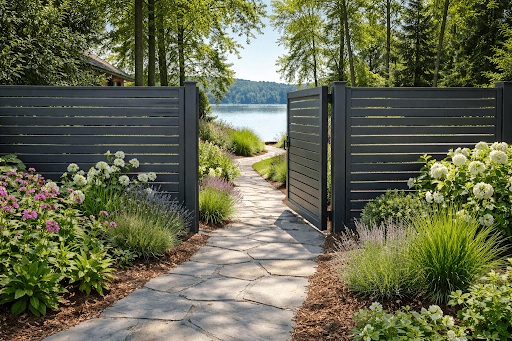
Required gate hardware for Canadian pool fences:
- Self-closing hinges: Spring-loaded or hydraulic hinges that pull the gate shut automatically. Adjust tension so the gate closes from any open position.
- Self-latching mechanism: Magnetic latches or gravity latches that engage without manual operation. The latch must hold the gate securely against wind pressure.
- Lock option: Many municipalities recommend (and some require) a keyed lock or combination lock on pool gates.
PrimeAlux aluminum gates are pre-drilled for self-closing hinge hardware and magnetic latching systems. The gate frames match the panel style (privacy, semi-privacy, or horizontal), so the enclosure looks consistent all the way around the pool.
For wider openings like pool deck access from a driveway, sliding gate hardware accommodates spans up to 20 feet without the swing clearance that a hinged gate requires.
How do you install an aluminum pool fence?
The installation process is similar to any perimeter fence, with a few pool-specific wrinkles. Most homeowners hire a contractor because the code compliance and permit process demand precision, and a failed inspection means rework.
Step 1: Survey and permit. Contact your municipality’s building department before starting. Most Canadian cities require a fence permit for pool enclosures. The permit process confirms your planned fence height, gate placement, and setback distances meet local bylaws.
Step 2: Post layout. Mark post locations every 6 to 8 feet around the pool perimeter. Posts should sit at least 1.2 m from the pool edge (check your local code for exact setbacks). For concrete pool decks, posts mount into surface brackets. For soil or gravel, posts are buried 3 feet underground in concrete footings.
Step 3: Post installation. Dig post holes 10 to 12 inches in diameter and 3 feet deep. Set aluminum posts in concrete, plumb each one, and let the concrete cure for 24 to 48 hours. For deck-mounted installations, use anchor bolts rated for the expected wind load.
Step 4: Panel attachment. Slide or clip panels between posts. PrimeAlux panels use a bracket system that allows for slight grade adjustments without cutting panels. On sloped ground, panels can be stair-stepped to maintain consistent height above grade.
Step 5: Gate installation. Hang the gate with self-closing hinges, install the self-latching mechanism, and test both from every angle. The gate should close and latch from any open position, including when wind pushes against it.
Step 6: Inspection. Schedule a municipal inspection before using the pool. The inspector will verify fence height, gap dimensions, gate hardware function, and overall compliance with your permit.
A professional installer typically completes a 60-foot pool enclosure in one to two days. Labour costs in Canada range from $15 to $30 per linear foot, depending on site access and ground conditions.
Does a pool fence affect home resale value?
A properly fenced pool adds value. An unfenced pool can actually reduce it. The Appraisal Institute of Canada notes that pools with code-compliant enclosures get more favourable assessments than open pools because they carry lower liability risk for homeowners and insurers.
The Insurance Bureau of Canada confirms that many home insurance policies require pool fencing as a condition of coverage. Without a compliant fence, you may face higher premiums or coverage exclusions. Some insurers offer 5% to 10% premium discounts when a pool has a code-compliant enclosure with self-closing gates.
Buyers with children commonly rank pool safety features as a top concern when evaluating homes with pools. A clean aluminum enclosure signals responsible ownership and removes a common negotiation sticking point during resale.
Bottom line: a pool fence protects your family and your wallet. The code requires it, your insurer expects it, and your future buyer will want to see it.
Frequently Asked Questions
How tall does a pool fence need to be in Ontario?
Ontario doesn't set one province-wide pool fence height, it's set by each municipality's own bylaw. Toronto requires 1.2 metres for single residential properties (1.8 metres for multi-residential), while Hamilton and Ottawa both require 1.5 metres. See our Ontario pool fence requirements guide for the details, and confirm with your local building department before building.
Can I use aluminum fencing around a saltwater pool?
Aluminum is one of the best materials for saltwater pool environments. Unlike steel or wrought iron, aluminum does not corrode when exposed to salt. The natural aluminum oxide layer protects the base metal, and powder-coated finishes (like those on PrimeAlux panels) add an additional barrier against salt spray, chlorine, and UV degradation.
How far from the pool does the fence need to be?
Most Canadian municipalities require pool fences to be at least 1.0 to 1.5 metres from the water’s edge. This setback keeps the fence outside the splash zone and provides safe passage around the pool perimeter. Exact distances vary by municipality, so confirm with your local building department before setting post locations.
Do I need a permit to install a pool fence in Canada?
Yes, in most Canadian municipalities. Pool enclosures are regulated structures that require building permits. The permit process ensures your fence meets height, gap, gate hardware, and setback requirements. Penalties for unpermitted pool fences vary but can include fines and mandatory removal. Always pull the permit before starting construction.
What is the best colour for a pool fence?
Black is a popular pool fence colour choice in Canada. Black recedes visually, making the pool area feel more open and unobstructed. It also hides water marks and pool chemical splashes better than lighter colours. PrimeAlux offers aluminum pool fence panels in black and other standard finishes.
How long does an aluminum pool fence last?
Aluminum pool fencing lasts 25 to 30 years or more with zero structural maintenance. The aluminum alloy does not rust, rot, or become brittle in cold temperatures. Powder-coated finishes maintain their colour for 15 to 20 years before any touch-up might be needed. Compare this to wood (10 to 15 years) or vinyl (12 to 18 years, with cold-weather cracking risk).
Can I install an aluminum pool fence myself?
DIY installation is possible if you are comfortable with post-hole digging, working with concrete, and reading building code specifications. The main challenge is meeting code requirements precisely enough to pass a municipal inspection. Many homeowners choose to hire a contractor for pool fence installation specifically because a failed inspection means rework, and an uncompliant fence may void insurance coverage.
Does pool fencing need to go all the way around the pool?
Yes. Canadian building codes require pool barriers to completely enclose the pool area with no gaps in the perimeter. The house wall can serve as one side of the enclosure if it has no direct-access doors or windows to the pool area, or if those openings have code-compliant alarms or self-closing mechanisms.
