
Black Aluminum Fence: The Colour Canadian Homeowners Pick Most
Black is the most popular fence colour in Canada, and it is not close. According to a 2023 survey by the Aluminum Association, more than 65% of residential aluminum fence orders in North America specify black or dark finishes. A black aluminum fence works with modern townhouses in Toronto, lakefront cottages in Muskoka, and suburban backyards in Calgary without clashing with anything.
This guide breaks down why black dominates, how it compares to other finishes and materials, what Canadian homeowners should expect for cost, and how to pick the right style for your property.
Why Is Black the Most Popular Aluminum Fence Colour?
Black aluminum fencing outsells every other colour because it disappears into the landscape instead of competing with it. White and beige fences pop against greenery and draw the eye to the property boundary. Black does the opposite: it recedes, making the yard feel bigger and more open even though it is fully enclosed.
The National Association of Home Builders reported in 2024 that 72% of homeowners who replaced a fence chose a neutral colour, with black being the top choice. Real estate agents in the Greater Toronto Area consistently recommend black fencing for curb appeal because it photographs well in listings and does not clash with seasonal landscaping changes.
There is also a practical reason. Black finishes hide surface dust and minor scuffs better than lighter colours. A black aluminum fence looks clean with nothing more than an occasional rinse from a garden hose, while a white fence shows every water stain and pollen deposit.
From a resale perspective, black is the least polarizing colour choice. A fence in an unusual colour can turn off buyers, but black reads as timeless. According to a RE/MAX Canada market analysis, properties with well-maintained black metal fencing sell within 5% of asking price more consistently than those with white or natural wood fencing.
What Styles Are Available in Black Aluminum Fencing?
Black aluminum fences come in every major style category, from full privacy panels to decorative picket designs. The most common configurations for Canadian properties include privacy, semi-privacy, and ornamental options.
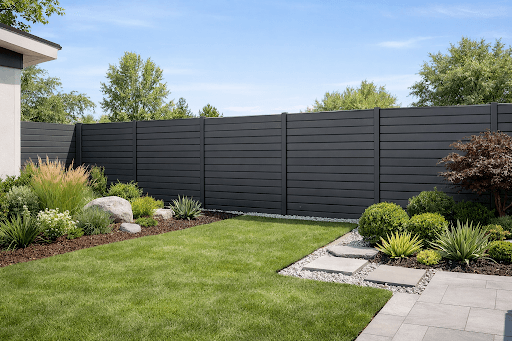
Privacy panels use solid horizontal slats with no gaps. These are the most requested style for backyard perimeters, pool enclosures, and properties that border busy streets. PrimeAlux privacy panels come in sizes from 4 feet by 6 feet up to 8 feet by 8 feet, with custom configurations available on request.
Semi-privacy panels use spaced slats that let air through while limiting visibility. They work well for front yards where municipal bylaws cap fence height or opacity, and for side yards where you want wind circulation without a fully open sightline. The full range of semi-privacy aluminum fence options is worth a look if you are weighing privacy against airflow.
Privacy Plus panels go further with foam-core construction sandwiched between aluminum skins. The foam core adds rigidity and a degree of sound dampening, which makes these panels a strong pick for properties near highways or commercial zones. The Privacy Plus line is the premium tier of PrimeAlux fencing.
A study by Houzz Canada found that horizontal slat designs increased in popularity by 38% between 2021 and 2024, with black finishes leading the trend. Horizontal lines create a modern aesthetic that works particularly well with contemporary architecture, which is why you see them on new builds across the GTA, Vancouver, and Calgary.
How Does a Black Aluminum Fence Compare to Black Vinyl or Black Wood?
The comparison comes down to longevity, maintenance, and how the material holds its colour over time. Here is what to expect from each option in a Canadian climate:
| Feature | Black Aluminum (PrimeAlux) | Black Vinyl | Black Wood (Stained) |
|---|---|---|---|
| Lifespan | 25+ years | ~10 years before fading/cracking | 8-12 years structural |
| Colour retention | Holds finish consistently | Fades and yellows within 3-5 years | Needs re-staining every 2-3 years |
| Maintenance | Zero (occasional rinse) | Periodic cleaning, no repair option when cracked | Stain every 2-3 years, replace rotted boards |
| Wind resistance | Tested to 220 km/h | Cracks in extreme cold, warps in heat | Warps and leans over time |
| Fire rating | ASTM E84 Class A (Flame Spread 0) | Melts and burns | Combustible |
| Freeze-thaw performance | No expansion/contraction issues | Becomes brittle below -20°C | Posts rot below grade |
| 10-year total cost | Lower (no maintenance spend) | Moderate (replacement sections) | Highest (staining + repairs + replacement) |
The Canadian Standards Association notes that extreme temperature cycling, which is standard across most of Canada, accelerates material failure in both vinyl and wood. Black vinyl fences are especially vulnerable because the dark pigment absorbs more solar heat, which causes faster warping and brittleness. Cheap imported vinyl products, which make up a large share of the Canadian market, can show these problems within just a few years.
A black wood fence may look striking on day one, but within one to two Canadian seasons, the stain starts to grey, crack, and peel. Most homeowners who pick black-stained wood end up re-staining it repeatedly or giving up and living with a greying fence that looks nothing like what they originally installed.
PrimeAlux takes a different approach: a 3-layer coating process applied to aluminum coils that locks in the colour before panels are formed. The coating does not peel, chip, or fade the way paint or stain does on wood, because it is bonded to the metal at the manufacturing stage rather than applied as a surface treatment after the fact.
How Much Does a Black Aluminum Fence Cost in Canada?
For a Canadian homeowner, expect to pay roughly $80 to $120 per linear foot installed for a black aluminum privacy fence. This range covers standard panel heights (6 feet) on flat terrain with concrete post footings buried 3 feet below grade. More complex installations, like sloped properties or taller panels, will push toward the higher end.
That per-foot price includes the panels, posts, hardware, and professional installation. For a typical 150-linear-foot backyard perimeter, the total project falls between $12,000 and $18,000, which is competitive with a high-quality wood fence build and significantly less than composite alternatives.
The Canada Mortgage and Housing Corporation’s 2024 renovation cost data shows that homeowners spend an average of $8,500 on wood fencing for a similar perimeter, but that number does not account for the $1,500 to $2,500 in maintenance costs that accumulate over the first 10 years. When you factor in staining, board replacement, and eventual full replacement, aluminum costs less over a 20-year window.
For a detailed breakdown of Canadian fence pricing, see our aluminum fence cost guide.
Does a Black Fence Make a Yard Look Smaller?
No. The opposite is usually true. Black fencing creates the visual illusion of more space because the eye passes over it rather than stopping at it. A white or brightly coloured fence draws attention to the boundary line, which makes the enclosed area feel more confined.
Landscape architects have documented this effect consistently. A 2022 study published in the Journal of Environmental Psychology found that dark boundary elements reduced perceived enclosure by 15-20% compared to light-coloured boundaries of the same height. The human eye registers dark objects as further away, especially when they are surrounded by green vegetation.
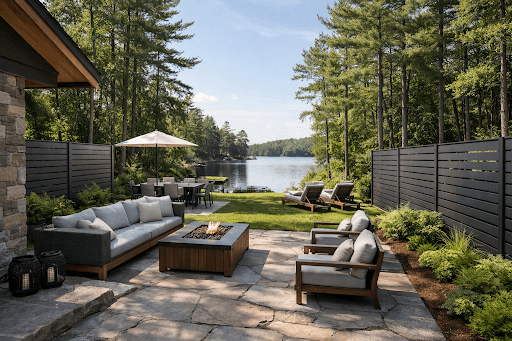
This is why black is the standard choice for properties where curb appeal matters. A black fence frames a garden without visually shrinking it. The same fence in white would create a boxed-in feeling, particularly in smaller urban yards where every visual inch counts.
For front yards, black aluminum picket-style fencing is especially effective. It defines the property line clearly for safety and aesthetics while maintaining an open, welcoming look. Many Canadian municipalities have front-yard fence height restrictions (typically 3 to 4 feet), and black aluminum at that height looks intentional rather than imposing.
What Finish Options Are Available Beyond Standard Black?
PrimeAlux offers five wood-grain finishes applied through a 3-layer coating process: Natural Walnut, Grey Walnut, Walnut, Dark Walnut, and Grey Brown. All of these are applied to aluminum coils before panel fabrication, so the finish is embedded in the material rather than painted on.
The wood-grain options appeal to homeowners who want the look of natural wood without any of the upkeep. Dark Walnut is a strong pick for anyone torn between the warmth of wood and the practicality of aluminum. From the street, it reads as rich dark wood, but it never needs staining, sealing, or replacement.
Standard black (matte or satin, depending on the product line) remains the top seller because it matches everything. But the wood-grain options have grown in demand, especially in established neighbourhoods where homeowners want a fence that blends with existing cedar or stone landscaping.
According to the Aluminum Extruders Council, demand for textured and wood-grain aluminum finishes grew 24% year over year in 2024 across the North American residential market. The trend is driven by homeowners who previously would have chosen wood but are switching to aluminum after learning about maintenance realities.
If you are comparing aluminum fence styles, the choice between black and wood-grain often comes down to architecture. Modern and contemporary homes lean toward matte black. Traditional and craftsman-style homes often look better with Dark Walnut or Grey Brown.
How Long Does a Black Aluminum Fence Last in Canadian Winters?
A properly installed black aluminum fence lasts 25 years or longer in Canadian winter conditions with zero structural maintenance. Aluminum does not rust, rot, or warp. It does not become brittle in cold temperatures the way vinyl does. And it is completely unaffected by the freeze-thaw cycles that destroy wood posts and crack vinyl panels year after year.
Environment Canada data shows that most Canadian fence installations experience between 50 and 120 freeze-thaw cycles per year, depending on the region. Each cycle puts stress on materials that absorb moisture, wood and vinyl chief among them. Aluminum is non-porous, so it absorbs no moisture and experiences no expansion or contraction from freezing.
PrimeAlux panels are tested to withstand wind loads up to 220 km/h, which covers the peak wind speeds recorded in every Canadian province. The panels are also fire rated Class A under ASTM E84, with a Flame Spread Index of 0 and a Smoke Developed Index of 50. You can review the full test data on the ASTM E84 fire test page.
The coating is equally important for longevity. PrimeAlux’s 3-layer process means the black finish resists UV degradation, salt spray (relevant for coastal properties in BC, the Maritimes, and lakefront homes), and road salt splash in urban settings. A fence installed in 2026 will look the same in 2036, which is something no wood or vinyl fence can claim.
Can You Install a Black Aluminum Fence Yourself?
Yes, but professional installation is recommended for most homeowners. DIY is feasible if you are comfortable with post hole digging (posts must be buried 3 feet deep to meet frost line requirements in most Canadian provinces), mixing concrete, and working with a level across long runs.
The main challenge with DIY aluminum fence installation is getting the posts plumb and evenly spaced over the full run. A single post that is off-level by even half an inch will create a visible lean across multiple panels. Professional installers use string lines and laser levels to prevent this.
For homeowners who want to tackle it themselves, the aluminum fence post guide covers sizing, depth, and installation methods in detail. PrimeAlux panels are designed for relatively straightforward assembly once the posts are set, which is one reason contractors prefer aluminum over wood. There are fewer cuts, fewer fasteners, and no need for staining after installation.
Professional installation typically adds $25 to $40 per linear foot to the project cost. For a 150-foot perimeter, that is $3,750 to $6,000 in labour. Many homeowners find this worthwhile because it comes with a workmanship warranty and eliminates the risk of post alignment issues.
What Should You Look for When Buying a Black Aluminum Fence?
Not all black aluminum fences are built the same. A few things are worth checking before you commit:
Start with the coating method. Ask whether the finish is powder coated, wet painted, or coil coated. Coil coating (what PrimeAlux uses) applies the finish to flat aluminum coils before forming, which creates a more uniform bond. Powder coating is applied after fabrication and can chip at cut edges or fastener points over time.
Then look at the alloy grade. The alloy determines strength and corrosion resistance. Some suppliers label products as “aluminum” when the actual alloy grade is far below what the name implies. Ask for the specific alloy designation.
Panel construction matters too. Solid single-wall panels are lighter and cheaper. Foam-core panels (like PrimeAlux Privacy Plus) are heavier, more rigid, and offer better wind resistance and acoustic performance. The construction method matters more than panel thickness alone.
Check for wind and fire testing. Many fence companies claim wind resistance with no test data to back it up. Ask for the specific test standard and results. PrimeAlux’s 220 km/h wind load rating and ASTM E84 Class A fire rating are verified and published, which puts them well ahead of competitors who rely on unsubstantiated marketing claims.
Finally, read the warranty carefully. Many fence warranties contain clauses that are nearly impossible to fulfil: annual professional inspections, specific cleaning products, or written notice within narrow time windows. Contact PrimeAlux directly for warranty details specific to your purchase.
How Does Black Aluminum Fencing Work for Pool Enclosures?
Black aluminum is the default choice for pool fencing in Canada because it meets municipal safety codes while maintaining an open, attractive look. Most Canadian municipalities require pool fences to be at least 5 feet tall with self-closing, self-latching gates and no climbable horizontal rails on the exterior face.
Aluminum gates with self-closing hinges and magnetic latches satisfy pool code requirements out of the box. The black finish is especially popular for pool areas because it does not show water spots, chlorine residue, or sunscreen stains the way lighter finishes do.
Semi-privacy panels are the most common choice for pool perimeters because they provide partial screening from neighbours while allowing airflow that reduces humidity buildup around the pool deck. Full privacy panels are used when the pool is close to a property line or faces a public area.
For a detailed look at pool fencing requirements across Canadian provinces, see our aluminum pool fence guide.
Frequently Asked Questions
Does a black aluminum fence rust?
No. Aluminum does not contain iron, so it cannot rust. Unlike steel or wrought iron fencing that develops orange corrosion over time, aluminum is naturally corrosion-resistant. PrimeAlux adds a 3-layer coating process on top of the base aluminum, which provides additional protection against UV exposure, salt spray, and surface scratching.
Will a black aluminum fence fade in the sun?
High-quality coil-coated aluminum fences resist UV fading for decades. PrimeAlux’s 3-layer coating process bonds the colour to the metal at the manufacturing stage, not as a surface paint. This is different from painted or powder-coated fences, where the finish sits on top of the metal and can degrade under prolonged UV exposure over several years.
Is a black aluminum fence good for dogs?
Yes. Privacy and semi-privacy aluminum panels have no gaps large enough for dogs to squeeze through or get their heads stuck in. The panels are rigid enough that even large dogs cannot push through them, and aluminum does not splinter the way wood does when dogs scratch or chew at fence boards.
Can you paint an aluminum fence a different colour later?
Technically yes, but it is not recommended. The factory-applied coil coating outperforms any field-applied paint in durability and adhesion. If you paint over a coil-coated fence, the paint layer becomes the weak point and will peel or chip years before the original coating would have shown any wear.
How tall can a black aluminum fence be in Ontario?
Ontario municipalities typically allow 6-foot rear yard fences and 3 to 4-foot front yard fences without a permit. Heights above 6 feet may require a building permit and engineering approval. PrimeAlux panels are available up to 8 feet tall for commercial and custom residential applications. Check your local municipal bylaw before ordering.
Does black aluminum fencing increase property value?
According to multiple Canadian real estate analyses, a well-maintained metal fence adds between 2% and 5% to a property’s perceived value. Black aluminum fencing specifically scores well because it is low-maintenance, long-lasting, and visually neutral, meaning it appeals to the broadest range of buyers.
How do you clean a black aluminum fence?
Rinse it with a garden hose once or twice a year. For stubborn dirt or pollen buildup, use mild dish soap and a soft cloth. Do not use abrasive cleaners, steel wool, or pressure washers on high settings, as these can scratch the coating. Most homeowners report spending less than 15 minutes per year on fence cleaning.
Is aluminum fencing recyclable?
Yes. Aluminum is one of the most recyclable materials on the planet, and it can be recycled indefinitely without losing quality. PrimeAlux panels contain up to 70% recycled aluminum content. At the end of the fence’s life (which is 25+ years out), the panels can be recycled again rather than sent to a landfill.
