
Metal Fence Panels: Types, Materials and How to Choose the Right One
Metal fence panels are the most durable fencing option for Canadian homeowners, but not all metal panels perform equally. Steel rusts. Galvanized coatings eventually fail. Aluminum holds up without any of that. Knowing the differences before you buy saves you from replacing the whole fence in a decade.
- Metal fence panels come in aluminum, steel, wrought iron, and galvanized steel — aluminum is the only option that won’t rust in Canadian conditions.
- Aluminum panels cost roughly $80–$120 per linear foot installed and typically outlast steel or galvanized alternatives by 15+ years without any maintenance.
- Panel style (privacy, semi-privacy, ornamental) matters as much as material — the right combination depends on your yard, HOA rules, and how much visibility you want to allow.
- PrimeAlux aluminum panels are wind-load tested to 220 km/h and carry a Class A ASTM E84 fire rating — specs most steel or vinyl competitors don’t publish.
What are the main types of metal fence panels?
Metal fence panels fall into four main material categories: aluminum, steel (including galvanized and powder-coated), wrought iron, and chain link. Each handles Canadian weather differently, and the gaps in long-term performance are wider than most homeowners expect when comparing initial prices.
Aluminum is the top choice for residential properties. It doesn’t rust, holds its finish for 25+ years, and weighs significantly less than steel — which matters when spanning long fence lines or installing on uneven ground. Residential aluminum privacy panels typically use hollow slat construction or, in higher-end products, a foam-core build for added rigidity.
Steel and galvanized steel panels offer high initial strength but need ongoing maintenance. Galvanized coatings begin failing under Canadian freeze-thaw cycles — especially near driveways and front yards where road salt is present. Once the coating cracks, surface rust spreads quickly from the exposed edges and fastener holes outward.
Wrought iron is the traditional ornamental option: heavy, structurally strong, and visually distinctive. The maintenance requirement is the problem. Wrought iron needs repainting every few years to prevent rust, and repairs are expensive because custom ironwork isn’t a standard offering in most markets.
Chain link uses galvanized or vinyl-coated steel wire. It’s inexpensive and holds up structurally, but it offers zero privacy and is mostly used in utility or commercial applications.
| Metal type | Rust risk | Typical lifespan (Canada) | Maintenance | Best use |
|---|---|---|---|---|
| Aluminum | None | 25+ years | Zero (occasional cleaning) | Residential privacy, backyards, pools |
| Galvanized steel | Moderate (coating degrades) | 8–15 years | Inspect and touch-up coatings | Commercial perimeter, industrial |
| Wrought iron | High (requires paint) | 20+ years with maintenance | Repaint every 3–5 years | Ornamental, heritage properties |
| Chain link | Low-moderate | 15–20 years | Minimal | Utility, pet enclosures, sports |
How do aluminum metal fence panels hold up in Canadian winters?
Aluminum fence panels are unaffected by freeze-thaw cycles, road salt, and moisture — the three forces that degrade other fencing materials in Canadian climates. The metal expands and contracts with temperature, but because aluminum’s thermal expansion rate is predictable and panels are designed with appropriate tolerance, this causes no cracking or joint failure over time.
Steel and galvanized panels respond differently. Every freeze-thaw cycle creates small stress points in the protective coating — especially at cut edges and fastener holes where the coating is thinnest. Cold temperatures cause the base steel to contract while the coating loses flexibility, which speeds up micro-cracking and lets moisture in. Rust follows quickly once that starts.
Road salt is worth thinking about for any property near a driveway or a salted street. Salt accelerates corrosion on steel considerably, shortening a galvanized fence’s useful life well below what specs suggest under protected conditions. Aluminum is inert to salt — it’s used in marine applications and coastal construction for exactly that reason.
PrimeAlux aluminum panels are wind-load tested to 220 km/h. That’s well above the design wind speeds required for residential fencing anywhere in Canada. Most steel fence products sold here don’t have published wind-load test data. The number just doesn’t appear in their specs.
What metal fence panel styles are available for residential use?
Metal fence panels for residential properties come in three main style categories: privacy, semi-privacy, and ornamental. The right choice depends on what you need the fence to do — block sightlines, let airflow through, or add visual definition to the property without full enclosure.
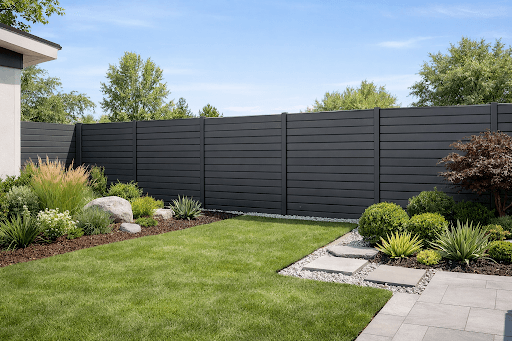
Privacy panels use solid or tightly spaced slats with no visible gaps. Full privacy is the default choice for backyards, pool enclosures, and anywhere you want a complete visual barrier. PrimeAlux privacy aluminum fence panels are available in heights up to 8 feet and panel sizes up to 8’x8′, so they cover full-height applications without stacking sections.
Semi-privacy panels use spaced slats — typically with 1–2 inch gaps. Airflow passes through freely, which matters in areas with heavy snowfall. Solid panels can catch wind and snow load in ways that stress posts and footings. Semi-privacy aluminum fence panels work well for front yards where some visibility is acceptable, or any area where wind load is a concern.
Ornamental and picket-style panels are open designs used for property definition rather than privacy. Common in front yards, around gardens, and in commercial landscaping. These are chosen as much for aesthetics as function.
One more option worth knowing: Privacy Plus panels use foam-core construction for improved rigidity, better insulation at the fence line, and reduced noise transmission. PrimeAlux’s Privacy Plus aluminum fence panels are the right call for applications where the fence is close to a house wall, pool equipment, or outdoor living area.
How do metal fence panel costs compare in Canada?
Installed metal fence panel costs in Canada vary by material. Aluminum privacy panels for residential use typically run $80–$120 per linear foot installed. Steel ornamental fencing is $60–$110. Wrought iron is the most expensive, running $100–$200+ per linear foot due to fabrication complexity and weight.
Those upfront numbers don’t tell the full story. A galvanized steel fence installed at $70 per foot and replaced at 12 years is more expensive over a 25-year horizon than an aluminum fence at $95 per foot that needs no maintenance at all. The true cost of aluminum fencing in Canada factors in zero maintenance, zero painting, and no early replacement — something steel can’t match.
Steel panels look cost-competitive at quote time. Maintenance costs — repainting, rust treatment, section replacement — don’t show up in the initial number. Over a 20-year window, a zero-maintenance aluminum fence is almost always cheaper in total cost of ownership.
What should I look for when buying metal fence panels in Canada?
The most important things to verify when buying metal fence panels are the material spec, the coating process, and whether the product has any independently verified performance data.
For aluminum panels, the alloy grade affects durability and how well the coating bonds. Commercial-grade aluminum extrusions typically use 6000-series alloys. Product listings that omit alloy grade entirely are worth questioning — there’s no good reason to leave it out if the spec is solid.
Coating quality matters more than most buyers realize. A 3-layer polyester powder coat holds color and resists UV degradation far longer than a single-coat finish. PrimeAlux uses a 3-layer coating process on all wood-grain finishes, which is why colors like Natural Walnut and Dark Walnut look consistent years after installation rather than fading unevenly.
Fire rating is worth checking for certain applications. If you’re fencing near a structure or in a higher fire-risk area, a Class A fire rating under ASTM E84 matters. PrimeAlux panels are Class A rated — Flame Spread Index 0, Smoke Developed Index 50 — which you can verify at the ASTM E84 fire test page. Most steel fence manufacturers don’t publish fire test results at all.
Post depth and concrete requirements: Metal panels transfer wind load through the posts into the concrete footings. In Canada, posts should be buried at least 3 feet deep — below the frost line — to prevent heaving and lean. Shallow installations are the most common cause of fence failure in Canadian climates. Read more about proper fence post depth for Canadian conditions.
| What to check | What good looks like | Red flag |
|---|---|---|
| Material spec | Alloy grade listed (e.g., 6063 aluminum) | “Aluminum alloy” with no grade |
| Coating | 3-layer powder coat or PVDF finish | Single coat, no process described |
| Wind rating | Published test result (km/h) | “Wind resistant” with no number |
| Fire rating | ASTM E84 Class A, published FSI/SDI | No rating listed |
| Panel size options | Multiple heights, custom available | One size only |
| Recycled content | % stated (e.g., up to 70% recycled) | No sustainability information |
How do metal fence panels compare to wood and vinyl?
The comparison with wood and vinyl comes down to one question: how much time and money do you want to spend maintaining your fence over the next 20 years? Metal — specifically aluminum — comes out ahead on every long-term metric. The aluminum vs wood fence comparison is clear for Canadian climates, and so is the aluminum vs vinyl comparison.
Wood fence panels may look attractive at installation but typically start showing cracking, greying, and warping within one to two seasons in Canadian weather. Cedar has a structural lifespan of 8–12 years and needs staining every 2–3 years to maintain appearance. Most homeowners skip the staining schedule and end up with a fence that looks weathered well before its structural life is over.
Vinyl is marketed as low-maintenance, which is partly true in mild climates. In Canada, lower-grade vinyl becomes brittle below -20°C and can crack under impact. Quality vinyl holds up for roughly 10 years before fading, yellowing, and surface cracking begin to show. When vinyl fails, it can’t be patched — the damaged section needs full replacement.
Aluminum panels need no painting, no staining, no rust treatment. Cleaning is occasional — a rinse when the fence looks dusty. That’s the entire maintenance schedule.
Which metal fence panel finish works best for a Canadian home?
Wood-grain aluminum finishes are the most popular residential choice in Canada. They give you the look of cedar or walnut without the upkeep that actual wood demands. PrimeAlux offers five wood-grain finishes — Natural Walnut, Grey Walnut, Walnut, Dark Walnut, and Grey Brown — all applied via a 3-layer coating process for long-term color stability.
Black aluminum panels are the most requested single finish, particularly for privacy fencing on contemporary homes. The black aluminum fence suits modern landscaping, complements dark exterior paint colors, and holds its finish well because black powder coat is among the most UV-stable options available.
Curb appeal and property value aren’t trivial considerations here. Fencing is one of the first things buyers and appraisers see on a property. An aluminum fence that still looks clean and finished five years in reads very differently than a greying wood fence that was never restained. Well-maintained aluminum fencing can contribute to a meaningful increase in perceived home value — weathered wood fencing does the opposite.
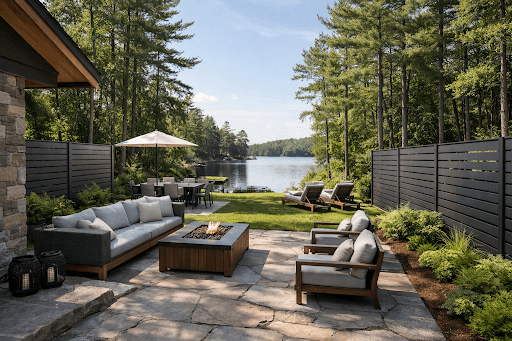
Gate panels should match the fence system in both material and finish. PrimeAlux aluminum gates are available in matching styles for all fence lines, including swing gate configurations and options compatible with motorized hardware.
Frequently asked questions
What are the best metal fence panels for a Canadian backyard?
Aluminum privacy fence panels are the best metal option for Canadian backyards. They don’t rust, withstand freeze-thaw cycles without cracking, and need zero maintenance. Choose full privacy slat panels for complete sightline blocking, or semi-privacy panels if some airflow is preferred. Posts should be set at least 3 feet deep below the frost line in most Canadian provinces.
Are metal fence panels more expensive than wood?
Aluminum metal fence panels typically cost more upfront — roughly $80–$120 per linear foot installed, versus $42–$85 per foot for wood. Over a 20-year horizon, aluminum is almost always cheaper in total cost of ownership. Wood needs staining every 2–3 years, occasional post repairs, and eventual full replacement within 8–12 years. Aluminum needs none of that.
How long do metal fence panels last in Canada?
Aluminum fence panels last 25 years or more in Canadian conditions without any maintenance. Galvanized steel typically lasts 8–15 years before the coating breaks down and rust begins. Wrought iron can last 20+ years but needs repainting every 3–5 years. Aluminum is the only metal fence material that delivers long-term performance in Canada without an ongoing maintenance commitment.
Do metal fence panels rust?
Aluminum fence panels don’t rust. Aluminum forms a thin protective oxide layer that prevents further corrosion. Steel panels, including galvanized steel, will rust once the protective coating fails — typically within 8–15 years in Canadian conditions. Wrought iron rusts quickly without regular painting. For rust-free performance, aluminum is the correct choice.
What size metal fence panels do I need?
Standard metal fence panels in Canada range from 4 to 8 feet in height and 4 to 8 feet in width. Most residential backyards use 6-foot privacy panels. Pool enclosures typically require at least 4-foot panels to meet provincial code. Custom sizes are available for non-standard spans or height requirements. Confirm sizing with your installer before ordering panels.
Can metal fence panels be used for pool enclosures in Canada?
Yes. Aluminum metal fence panels are a common choice for pool enclosures in Canada. Most provinces require pool fencing at least 1.2 metres high with no climbable footholds and self-closing latching gates. Aluminum meets these requirements and resists moisture, temperature swings, and chlorine exposure better than wood or vinyl alternatives.
What posts are required for metal fence panels?
Metal fence panels should be installed with aluminum or heavy-gauge steel posts set in concrete. Post depth must be at least 3 feet in Canada to clear the frost line in most provinces. Larger panels — 6’x8′ or 8’x8′ — may need wider or deeper footings. Undersized posts are the most common installation mistake and the leading cause of panel lean and early failure.
Are metal fence panels good for privacy?
Full-privacy aluminum fence panels provide complete visual blocking with no gaps between slats. Semi-privacy panels offer partial privacy with 1–2 inch spacing. For maximum privacy, choose solid-slat panels in heights of 6–8 feet. PrimeAlux privacy panels are available up to 8 feet high with foam-core options available for added rigidity and insulation at the fence line.
