
Aluminum Fence Gate: Styles, Hardware and Installation Tips for Canadian Homeowners
Quick Answer
An aluminum fence gate is a powder-coated, rust-proof gate built to integrate with an aluminum fence system. For Canadian homeowners, it typically costs $400 to $1,200 installed depending on width, height and hardware, lasts 25 or more years with zero maintenance, and meets pool safety codes when paired with a self-closing hinge and self-latching mechanism. The best aluminum fence gates match the panel style and finish of the fence they belong to, use stainless or heavy-duty aluminum hardware sized for Canadian freeze-thaw cycles, and arrive pre-fabricated so installation takes hours, not days.
Choosing an aluminum fence gate sounds simple until the first quote arrives and the contractor asks about hinge type, latch direction, post sizing, drop rod, magnetic safety lock and a dozen other details you did not think mattered. They do, especially in Canada. Frost heave, freezing latches, sagging hinges and warped wood gates that no longer close are the realities Canadian homeowners face. An aluminum fence gate solves most of those problems at the source, but only when it is specified and installed correctly. This guide walks you through every decision so you can buy with confidence.
What Is an Aluminum Fence Gate?
An aluminum fence gate is a gate fabricated from coated aluminum extrusions and panels, hung on aluminum or steel posts using engineered hinge and latch hardware. It is built to match the look and height of an adjoining aluminum fence so the property line reads as one continuous system. Unlike wood gates that sag from moisture or steel gates that rust at the welds, aluminum gates hold their shape and finish for decades.
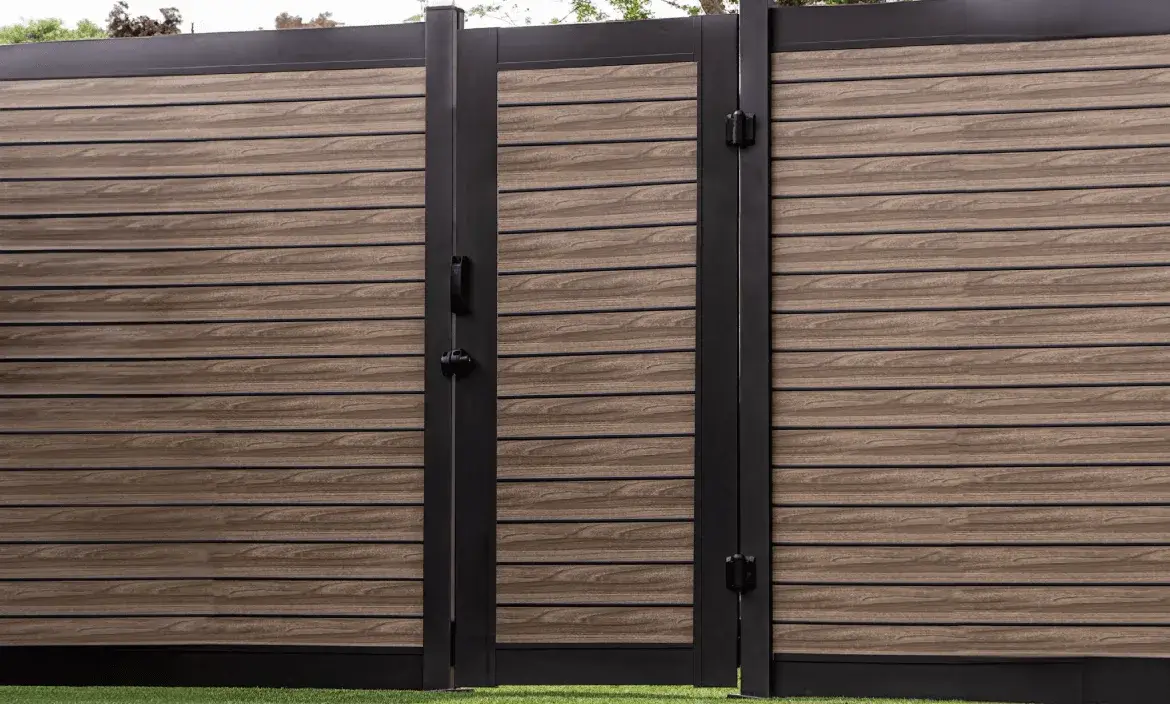
PrimeAlux aluminum fence gates use the same coated coil construction as the privacy and semi-privacy fence panels they pair with. That means the gate is fire-rated Class A under ASTM E84 testing (Flame Spread Index 0, Smoke Developed Index 50) and was tested to a wind load of 220 km/h alongside the panels. The aluminum content can be up to 70% recycled, which matters if you care about long-term embodied carbon. The finishes (Natural Walnut, Grey Walnut, Walnut, Dark Walnut and Grey Brown) apply through a three-layer wood-grain coating process, so the gate visually disappears into the fence rather than standing out as a different material.
Aluminum Fence Gate Styles That Suit Canadian Homes
Style choice comes down to two questions: how much visual privacy do you want, and what is the rest of your fence doing? An aluminum fence gate is almost always built to match the panels, so the panel decision drives the gate decision.
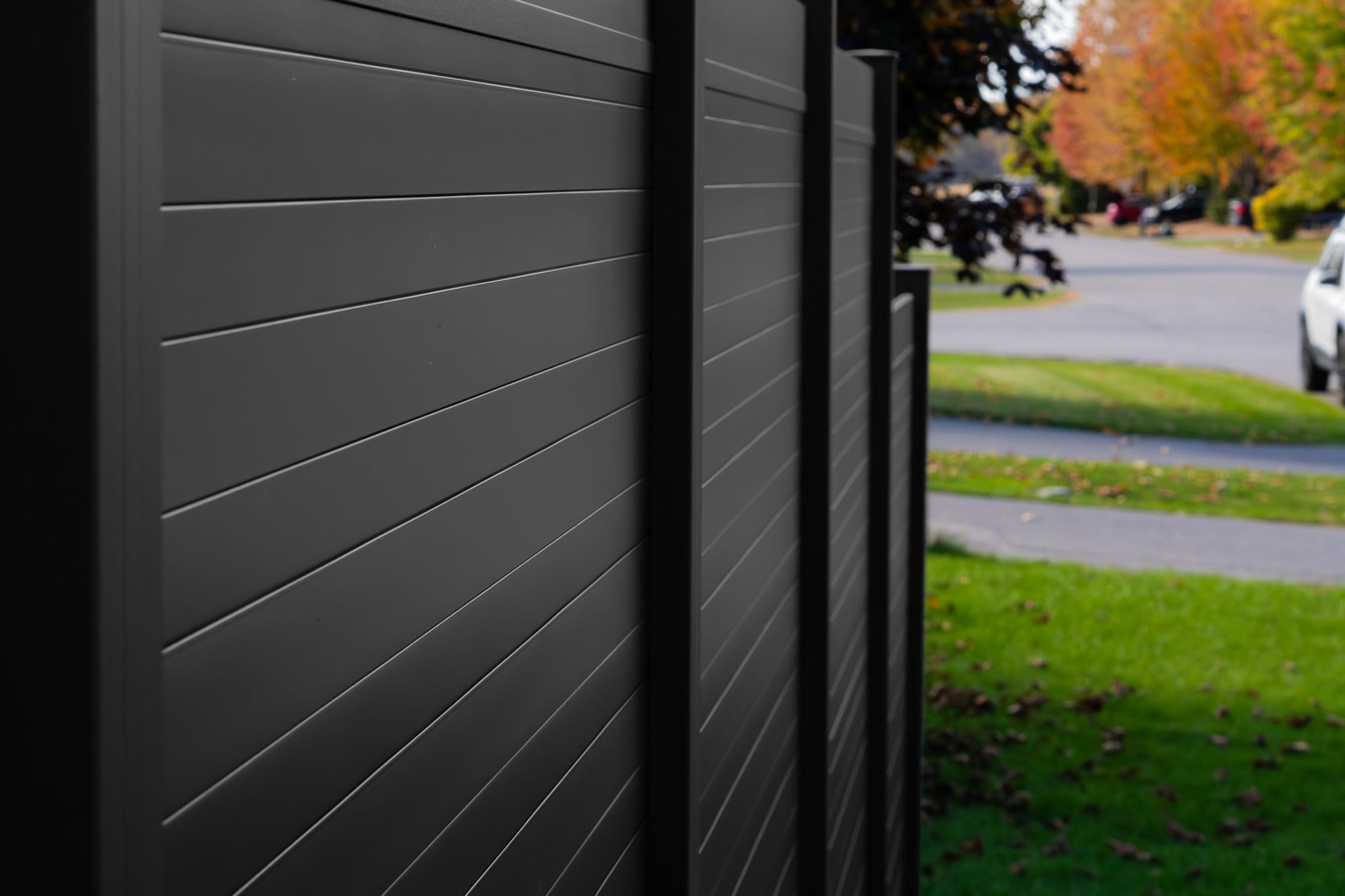
Full privacy gates use solid horizontal slat construction with no visible gaps. They suit pool enclosures, hot tub areas and any spot where a sightline from the neighbour or sidewalk is unwanted. PrimeAlux privacy aluminum fence panels and gates work well in this role and are the most popular option for backyard installations in Ontario and Quebec.
Privacy Plus gates use a foam-core construction inside the aluminum slats, adding mass that helps reduce wind noise and gives the gate a more substantial feel when it swings. If your property faces a busy road or you want a gate that closes with weight rather than rattles, look at Privacy Plus aluminum fence systems.
Semi-privacy gates use spaced slats that let airflow through while still blocking most direct sightlines. These work for windy areas (the airflow reduces wind load on the gate hardware), for front-yard sections where total opacity feels too closed off, and for properties where you want to maintain visual rhythm without sealing the yard off. The semi-privacy aluminum fence line covers this.
Ornamental gates use vertical pickets, sometimes with decorative scrolling, and pair with traditional homes or front-property installations. Most Canadian buyers move toward modern horizontal slat or full privacy styles, but ornamental is the right call when matching an existing wrought-iron aesthetic.
How an Aluminum Fence Gate Compares to Wood, Vinyl and Steel
Material choice for the gate matters more than for the fence panels. Gates move every day, get slammed, swell, freeze and bear the brunt of weather and use. Most fence failures start at the gate.
| Material | Typical Canadian Lifespan | Maintenance | Common Failure |
|---|---|---|---|
| Aluminum (PrimeAlux) | 25+ years | None (rinse occasionally) | Hardware wear over decades, not the gate itself |
| Cedar wood | 8 to 12 years structural; visibly degraded in 1 to 2 seasons | Re-stain every 2 to 3 years | Sagging, warping, latch misalignment, rotted hinge area |
| Pressure-treated wood | 7 to 10 years | Regular treatment | Warping, cracking, ground-contact rot at the hinge post |
| Vinyl | About 10 years before cracking, fading or warping begin | Periodic cleaning | Brittle cracking in deep cold; cannot be repaired once split |
| Steel (welded) | 15 to 20 years | Annual rust touch-ups required | Rust at welds and ground contact, weight strain on hinges |
Wood gates fail first because the hinge-side post takes constant lever-arm stress while sitting in ground that freezes, thaws, swells and dries on a yearly cycle. Vinyl gates do not rot but get progressively brittle in deep cold, and once a vinyl gate cracks the entire panel has to be replaced. Steel gates last but the welds rust where the coating chips, and a heavy steel gate puts ongoing strain on the post until the post itself starts to lean.
Aluminum sidesteps all of that. It does not rust, the post does not rot, and a well-built aluminum gate with proper hardware will outlast the house’s first roof. For context on long-term performance, see our breakdown of aluminum fence lifespan and how it actually plays out in Canadian climates.
Gate Hardware: What Actually Matters
The gate frame and panels are roughly half the story. The other half is hardware, and this is where most cheap gates fall apart. Three components decide whether the gate still closes properly five winters from now.
Hinges. Look for either heavy-duty stainless steel J-bolt hinges with self-closing tension built in, or self-closing aluminum hinges rated for the gate weight. A standard residential aluminum gate weighs around 25 to 45 lbs. Larger gates or Privacy Plus gates with foam-core construction weigh more. Always size hinges for at least 1.5 times the gate weight.
Latches. A latch should be self-latching at minimum, and lockable if the gate provides primary or secondary pool enclosure. Magnetic safety latches lock automatically when the gate closes and resist tampering, which is what pool codes generally require. For non-pool applications, a simple gravity latch with a key-lockable option is fine for most homeowners.
Drop rods and cane bolts. Double gates need a drop rod on the inactive leaf so the active leaf has something to latch into. Cane bolts (heavy duty drop rods) work for wider double gates and driveway-style aluminum gates.
Pro Tip
Specify the hinge side BEFORE the gate is fabricated. Once the latch hardware is installed on the wrong side, switching it usually means new holes through the frame and visible patches in the finish. Stand at the gate looking at it from the outside (the public side) and decide whether you want it to swing left or right. Tell the manufacturer.
Single, Double and Pedestrian Gate Configurations
Gate width drives the configuration. Single gates work up to about 5 feet wide before the lever arm becomes hard on hinges. Beyond that, double gates split the swing into two leaves and reduce strain.
Single pedestrian gates run 3 to 4 feet wide and are the standard for fenced backyards, side yards and pool enclosures. A 36-inch width is the most common request and accommodates a wheelbarrow, mower or stroller.
Double swing gates run from 6 to 14 feet total width and use two leaves that meet in the middle. Common driveway widths are 10 to 12 feet for a single-car drive and 12 to 16 feet for a two-car drive. One leaf typically stays fixed with a drop rod while the other swings open for daily access.
Sliding gates run on a track or rollers and suit driveways where there is not enough swing clearance. They are heavier and more complex than swing gates and the track has to stay clear of snow and ice through the winter. For driveway hardware specifics, see our sliding gate hardware overview.
If you are still deciding between gate types or want to see how they pair with different fence styles, the aluminum gates page covers the full PrimeAlux product range with measurements and finish options.
Pool Safety: Why Aluminum Fence Gates Meet Canadian Pool Codes
Every Canadian province has pool fencing requirements, and gates are where most pool fence inspections fail. The rules vary by municipality but the common requirements include a minimum fence height (usually 4 to 5 feet), self-closing and self-latching gates, latches mounted at or above 1.5 m on the pool side so small children cannot reach them, and no horizontal climbable elements on the outside face of the gate that could be used as a foothold.
Aluminum fence gates meet these requirements naturally. The slat construction on PrimeAlux privacy gates has no climbable horizontal rails on the outside. Magnetic self-latching mechanisms are widely available and install at the regulated height. The gate stays in alignment year-round (no sagging that prevents the latch from catching), which matters because a gate that almost latches is the most common reason pool fences fail inspection in Canada. For drowning prevention context, see Parachute Canada’s drowning prevention resources.
If a pool is your main reason for fencing, our guide to aluminum pool fence requirements covers code minimums province by province.
Cost: What Canadian Homeowners Pay for an Aluminum Fence Gate
Gate pricing in Canada is heavily driven by width, height, panel style and hardware quality. For context, PrimeAlux fence runs price roughly $80 to $120 per linear foot installed in the Canadian residential market. Gates fall outside that linear-foot logic because they include hardware, hanging labour and a heavier post pair.
A reasonable budget for a single residential aluminum fence gate, supplied and installed in Ontario or Quebec, runs $400 to $1,200. A 36-inch single privacy gate with standard self-closing hinges and a gravity latch lands near the low end. A 4-foot wide Privacy Plus gate with magnetic pool-rated hardware and a key-lockable mechanism lands closer to the higher end. Double driveway gates run $1,500 to $3,500 depending on width and whether automation is included. Always get a quote in writing that itemizes the gate, the hardware, the posts and the labour separately so you can compare quotes line by line. For broader pricing context, see aluminum fence pricing in Canada.
Installation: How to Install an Aluminum Fence Gate Properly
Gate installation is more demanding than panel installation because the posts have to handle daily movement. The four points that matter most:
Post depth. Hinge and latch posts for an aluminum fence gate should be set at 3 ft underground in most Canadian frost zones. This depth is below the typical frost line for southern Ontario, southern Quebec and the Lower Mainland and prevents frost heave from racking the gate out of alignment in winter. Anything shallower than 3 ft risks a gate that closes fine in October and refuses to latch by January. The same 3 ft burial applies to the panel posts and is non-negotiable on a gate run. More on this in our fence post depth guide.
Post size. Gate posts should be heavier than panel posts. A standard 2.5 inch panel post is not enough for a 4-foot privacy gate, especially with foam-core construction. Step up to a 3 or 4 inch gate post depending on the gate weight.
Plumb and parallel. The hinge and latch posts have to be plumb (vertical in both directions) AND parallel to each other. Even a half-inch of lean over six feet of post will show as a binding latch within a year. Use string lines and a 4-foot level, and check both posts against each other after concrete sets.
Concrete cure. Do not hang the gate until the post footings have cured for at least 48 hours. Hanging a 40-lb gate on green concrete is the fastest way to end up with a leaning post. For a full installation walkthrough, see our aluminum fence installation guide.
Matching Your Gate to Your Fence System
An aluminum fence gate should look like part of the fence, not a separate piece bolted into it. That means matching slat orientation, slat spacing and finish colour. PrimeAlux gates are fabricated from the same coated coils as the panels, so when you order Walnut privacy panels and a matching gate, the wood-grain pattern aligns. The advantage over wood and most vinyl systems is the colour consistency, since powder coating on aluminum stays true for 25+ years where stained wood drifts every season. If you are still selecting a finish, browse our aluminum fence colours guide. For homeowners researching the broader category, our pillar guide on aluminum privacy fence systems in Canada covers the full system view and how the gate fits in.
Frequently Asked Questions
How wide should an aluminum fence gate be?
For a standard pedestrian gate, 36 inches is the most common width and fits a wheelbarrow, lawnmower or stroller. For wider access (riding mowers, small trailers, a dump bin), go to 48 inches. Anything over 60 inches should be a double gate to keep hinge strain manageable.
Do aluminum fence gates rust?
No. Aluminum does not rust because it does not contain iron. The aluminum forms a stable oxide layer at the surface that protects the underlying metal. Combined with PrimeAlux’s three-layer powder coating, this means an aluminum fence gate will not develop the rust streaks or corrosion blooms that steel and iron gates develop in Canadian winters.
Are aluminum fence gates strong enough for security?
Yes for residential use. PrimeAlux aluminum gates use coated extrusions and panels that were tested to a 220 km/h wind load alongside the privacy panels. They will not be cut through with a kitchen knife or pushed open by a child. For high-security commercial applications you may want a thicker custom-fabricated gate, but for residential intrusion deterrence the standard system is appropriate.
Can I install an aluminum fence gate myself?
Yes, with the right tools and patience. The gate frame arrives pre-assembled and the hardware kit is straightforward. The hard part is setting the posts plumb and parallel. If you are confident with concrete post setting and have a level, a friend and a Saturday, a single gate install is achievable. Double gates and pool-rated gates are usually worth hiring out.
What happens if the gate sags?
A sagging aluminum fence gate almost always means the hinge post has shifted, not the gate itself. Aluminum gates do not warp the way wood does. Check that the hinge post is still plumb. If it has leaned, the fix is to reset the post (sometimes requires breaking out the concrete and re-pouring) rather than adjusting the gate. This is also why post depth and concrete cure time matter so much during install.
Do aluminum fence gates work in winter?
Yes. They do not freeze shut the way some vinyl gates can, and the latches stay operable as long as the latch mechanism is rated for outdoor cold-weather use. Some homeowners report that a thin coat of dry silicone spray on the latch mechanism in November keeps it moving smoothly through a Canadian winter.
How heavy is a typical aluminum fence gate?
A 36-inch wide standard privacy gate weighs about 25 to 35 lbs. A 48-inch Privacy Plus gate (foam-core construction) can weigh 45 to 60 lbs. Double driveway gates can be 100 lbs or more per leaf. Match your hinge selection to the actual gate weight, not a generic residential gate rating.
Can the gate hardware be replaced later?
Yes, and this is one of the long-term advantages of an aluminum gate. The frame outlives the hardware, so when latches wear out (usually 10 to 15 years for a heavily-used gate), the latch can be replaced with the gate still in place. The same is true for hinges. Buy decent hardware up front and you will not need to touch it for a long time.
The Bottom Line
An aluminum fence gate is the most important single component of a fence system because it is the part you actually interact with every day. Choosing the right one means matching the gate to the fence style, sizing the hardware for the real gate weight, setting the posts deep enough to survive Canadian freeze-thaw, and getting the swing direction right before fabrication. Done well, an aluminum fence gate will outlast every other gate material on the market and never need staining, sealing or rust treatment. Done poorly, it will sag, drag, fail to latch and become the visible weak point in an otherwise solid fence.
If you want to see how PrimeAlux aluminum fence gates pair with privacy and semi-privacy panels for your property, browse the aluminum gates collection or request a quote with your gate dimensions and preferred finish. For deeper context on the rest of the system, our pillar resource on privacy aluminum fence systems covers the panels, posts and components your gate will integrate with.
Sources and further reading: Natural Resources Canada, Aluminum Facts; The Aluminum Association, Recycling; ASTM E84-25 Standard Test Method for Surface Burning Characteristics.
