
Sliding Gate Hardware: What Canadian Homeowners Need for Smooth, Reliable Operation
Quick Summary
Sliding gate hardware in Canada needs to handle frost heave, snow loads, and salt exposure that most US-spec kits ignore. The right setup combines a galvanized or stainless V-track, sealed wheel carriages, a captured roller guide, and a positive latch with a backstop. Match the hardware to the gate weight (most residential aluminum gates run 80 to 220 lb) and to the opening width. Aluminum gates pair best with stainless rollers and adjustable carriages because they keep alignment year after year without rust streaks or seasonal binding.
What is sliding gate hardware and what does each piece do?
Sliding gate hardware is the full mechanical kit that lets a gate roll horizontally instead of swinging. A complete residential set includes a track or guide rail, two wheel carriages mounted to the gate, an upper guide roller bracket on the receiving post, a backstop or end roller, a catcher to stop and align the gate, a latch or lock, and the fasteners. Each piece does a specific job, and skipping any of them is the most common reason a sliding gate starts dragging or jumping the rail within a season.
For a Canadian climate, the hardware also has to deal with conditions most off-the-shelf kits are not built for. Snow piles up on the track. Frost shifts the posts a few millimetres each spring. Road salt and freeze-thaw cycles attack zinc plating. The hardware has to keep working while all of that happens. That is why pairing a quality aluminum gate with the right hardware matters more here than in milder regions, and why Canadian buyers should consider an aluminum gate guide before specifying parts.
There are two broad families of sliding gate systems. V-track systems use a steel rail set into or onto the ground, and the gate rolls on grooved wheels that ride the V. Cantilever systems have no ground track at all. The gate hangs from rollers attached to the support posts and counterbalances itself. V-track is simpler, cheaper, and ideal for level driveways. Cantilever is better for snowy yards where a ground track would constantly need shovelling, and it works on uneven terrain.
What are the main parts of a residential sliding gate system?
A residential sliding gate has six functional parts. Get all six right and the gate will run smoothly for decades. Skip one and you will be back at the hardware store before the second winter.
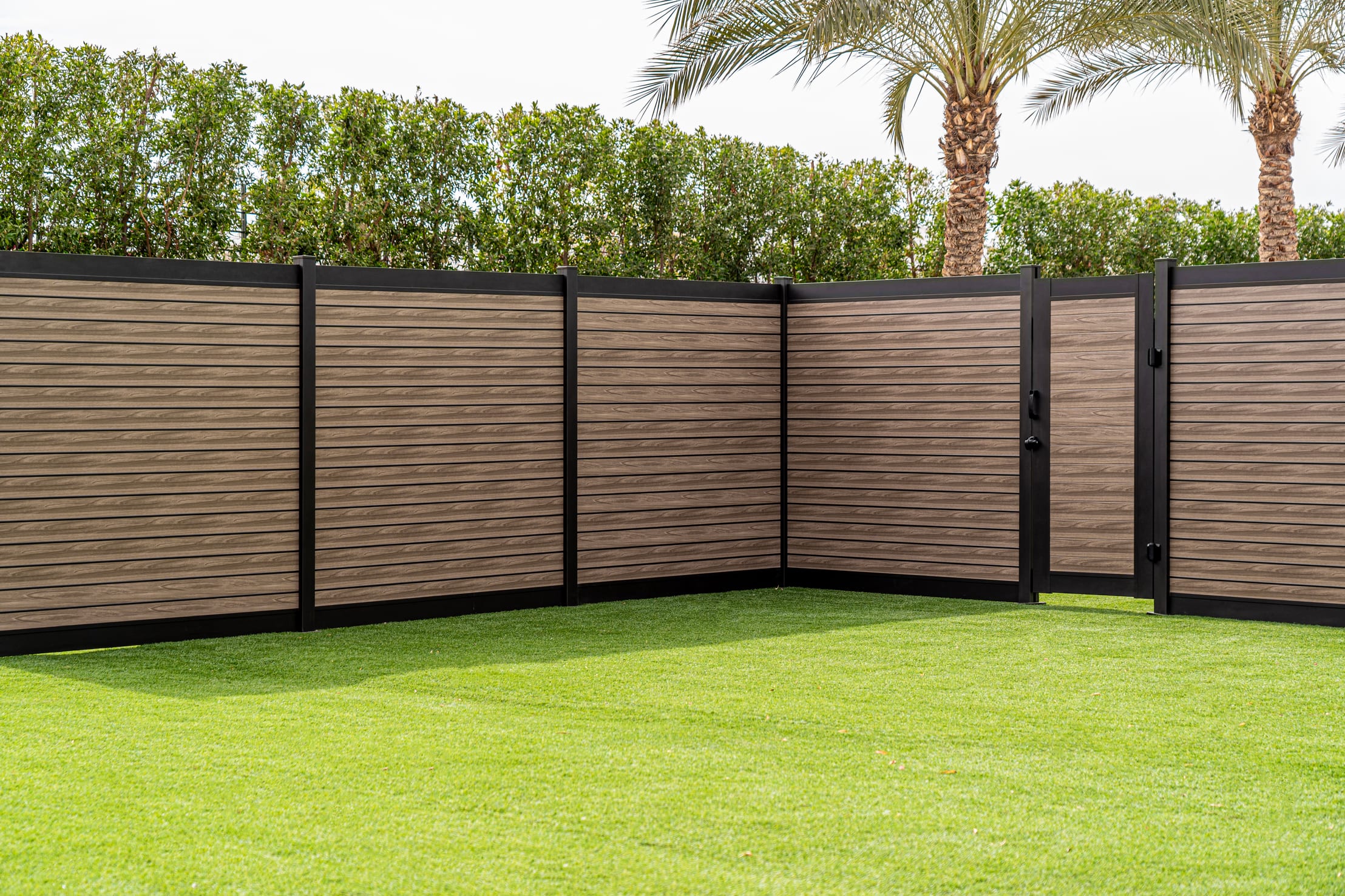
Wheel carriages. Two carriages bolt to the bottom rail of the gate and carry the full weight. They use sealed bearings on a hardened axle. For aluminum gates under 250 lb, 4 inch (100 mm) carriages with stainless or zinc plated steel housings are standard. Avoid plastic-bodied carriages for outdoor Canadian use. They go brittle below -25°C.
V-track or guide rail. The track is the steel rail the wheels ride on. For driveways, the most common choice is a 2 inch flat-bar V-track lagged into a concrete pad, or a heavier inverted-V channel for bigger gates. Galvanized track lasts 10 to 15 years in Canadian conditions. Stainless lasts longer but costs roughly three times as much.
Upper guide roller. Mounted to the receiving post above the gate, the guide roller keeps the top of the gate from swaying side to side as it moves. Most kits use a pair of nylon or polyurethane wheels in a steel U-bracket. Adjustable side wheels are worth the small price increase because gates settle and drift over time.
End stops and catcher. The end stop blocks the gate at the closed position. The catcher is a vertical post or pocket on the receiving side that the leading edge slides into. The catcher does two jobs. It stops the gate cleanly and it stiffens the closed gate against wind and tampering.
Latch or lock. Sliding gates do not latch the same way swing gates do. They typically use a hook latch, a slide bolt that drops into the catcher post, or a deadbolt-style lock if security is a priority. Pool gate codes also require self-closing and self-latching hardware where the gate is a barrier to a pool, which is covered in the pool fence Canada provincial requirements overview and the aluminum pool fence styles guide.
Fasteners. The hardware is only as strong as what holds it down. Use stainless or hot-dip galvanized lags into a concrete pad for the V-track. Use stainless bolts through the gate frame for the carriages. Plain zinc-plated hardware will rust through at the heads within five Canadian winters.
V-track vs cantilever vs ground roller: which type works for your driveway?
The right system depends on three things: how level the ground is, how much snow you get, and how much ground prep you want to do. Here is the honest comparison.
| System Type | Best For | Snow Performance | Cost (Hardware Only) | Lifespan |
|---|---|---|---|---|
| V-track (ground rail) | Level paved driveways | Track must be cleared after each snowfall | $220 to $480 CAD | 10 to 15 years (galvanized) |
| Cantilever (suspended) | Snowy yards, uneven ground | Excellent. No ground contact at all. | $650 to $1,400 CAD | 15 to 20 years |
| Ground roller (light duty) | Pedestrian and side gates only | Poor in heavy snow | $80 to $180 CAD | 5 to 10 years |
| Wheel-on-bottom (rolling gate) | Light residential driveways | Track must be cleared | $140 to $260 CAD | 8 to 12 years |
For most Canadian homes, the practical choice is between V-track and cantilever. V-track is cheaper and easier to install, but you will need to clear the track every time it snows. If a chunk of ice freezes in the V, the gate will not close. Cantilever costs more upfront but does not care about snow because nothing rides on the ground. If your driveway gets plowed regularly and you do not want a maintenance task, cantilever pays back its premium quickly.
How do you size sliding gate hardware to the gate?
Sizing is where most homeowners get this wrong. The hardware kit you buy has to handle three numbers: the gate weight, the gate length, and the opening width. Each affects which carriages, track, and rollers you need.
Gate weight. Aluminum is the lightest practical material for a driveway gate. A typical 12 ft (3.66 m) wide aluminum privacy gate weighs around 110 to 160 lb (50 to 73 kg). A matching steel gate would weigh 220 to 320 lb. The hardware rating must exceed the gate weight by at least 30 percent to leave headroom for snow load on top of the gate. PrimeAlux’s aluminum gates are designed for residential weight ranges and pair well with standard 4 inch carriages.
Gate length and travel distance. A sliding gate needs space to roll into. The full open position requires a parallel run equal to the opening width plus about 12 inches of overhang. So a 12 ft opening needs roughly 13 ft of clear fence line beside it. If you only have 8 ft of run, the gate can only cover an 8 ft opening (minus some overhang) when fully open.
Opening width. Standard residential driveway openings run 10 to 14 ft wide. Anything beyond 16 ft is technically possible with a single sliding gate, but the gate gets long, heavy, and flexes more in the middle. For wider driveways, two gates that meet in the middle (a bi-parting setup) is mechanically simpler than one giant slider.
What are the most important installation tips for Canadian conditions?
Sliding gate hardware fails in Canada for predictable reasons. Posts heave with frost. Tracks fill with ice. Lubricated bearings get sticky in extreme cold. Plain steel rusts through where salt spray hits. None of these are mysteries, and all of them have well-known solutions.
Pro Tip: post depth dictates everything.
In Canada, gate posts must be set below the frost line. The standard burial depth for aluminum gate posts is 3 ft (914 mm) in concrete. Anything shallower will heave each spring, throwing the gate out of alignment within one season. If you live in deeper frost zones (Northern Ontario, Alberta, the Prairies), 4 ft is safer. Concrete the posts straight, plumb, and let the footings cure for 48 hours before hanging hardware. For more on Canadian frost depth rules, see the how deep should a fence post be guide and the aluminum fence post sizing guide.
Mount the V-track to a concrete pad, not bare ground. Even a packed gravel base will settle and twist over time. Pour a 4 inch reinforced concrete strip the full length of the track, lag the track with stainless or hot-dip galvanized hardware, and slope the pad slightly so meltwater drains away from the track grooves.
Use sealed bearings rated for cold. Standard sealed-bearing carriages work down to about -30°C with the right grease. If you want certainty, look for carriages with low-temperature lithium or synthetic grease. They cost a bit more but stop the seasonal “grinding” sound that comes from regular grease thickening in the cold.
Build in adjustability. Posts move. Even properly installed posts shift a few millimetres over seasons. Adjustable carriages with vertical and horizontal screw adjustment let you re-align the gate in 5 minutes instead of pulling everything apart. The price difference between fixed and adjustable carriages is small. The labour difference if a fixed setup goes out of alignment is huge.
Cap the posts. Open post tops let water in. In Canada, water gets into the post, freezes, expands, and either splits the post or pops the welds at the base. A simple aluminum cap solves it permanently. Most quality fence systems include caps; if yours did not, buy them separately.
Check alignment in spring and fall. Two five-minute checks a year prevent every common sliding gate problem. In spring, look for any tilt that happened over winter and adjust the carriage screws if needed. In fall, clean the V-track grooves, lubricate the bearings, and tighten any fasteners that loosened over the summer.
Why aluminum gates pair best with sliding hardware in Canada
The gate material itself shapes how long the hardware lasts. Heavier gates beat up the carriages and bearings faster. Gates that warp out of square jam the rollers. Gates that rust shed flakes onto the track. Aluminum avoids all three problems.
Weight stability. Aluminum does not absorb water. A wood gate gains weight every wet season and loses it every dry one. The hardware sees a constantly changing load. Aluminum gates weigh the same on day one as they do in year ten, which means the carriages and track see a stable, predictable load.
No rust contamination. A steel or wrought iron gate eventually flakes rust onto whatever is below it. On a sliding gate, that rust ends up in the V-track. Once track grooves are pitted, the wheels start chattering and the bearings wear faster. Aluminum will not rust, full stop, so the track stays clean.
Dimensional stability. Aluminum does not warp with humidity. Wood gates twist as boards swell and shrink, and once a sliding gate is out of square, the rollers bind. Aluminum gates stay square through every Canadian season.
Tested performance. PrimeAlux aluminum systems are wind-load tested to 220 km/h, fire rated Class A under ASTM E84 (Flame Spread Index 0, Smoke Developed Index 50), and built with up to 70% recycled aluminum content. Pair that with a properly sized hardware kit and you have a gate setup that does not need replacement during the time wood gates would have been replaced twice. The same construction logic shows up in the aluminum fence lifespan picture and in long-term aluminum fence maintenance realities.
For a deeper look at how aluminum compares to other materials, the aluminum vs wood fence comparison covers the full lifespan and maintenance picture, and the aluminum vs vinyl comparison explains why imported vinyl gates struggle in Canadian winters.
What does a complete sliding gate setup cost in Canada?
A complete sliding driveway gate setup has three cost layers: the gate itself, the hardware kit, and the installation labour. Here is what to budget for a typical 12 ft residential opening in 2026.
Gate. A 12 ft aluminum sliding gate in a wood-grain or solid powder-coated finish usually runs $1,800 to $3,400 CAD depending on style (privacy, semi-privacy, ornamental) and finish. Custom heights or designs add 15 to 30 percent. For comparison, the typical installed homeowner price for full aluminum fence systems in Canada is $80 to $120 per linear foot installed, and a sliding gate is a one-time line item on top of that.
Hardware kit. A complete V-track residential kit (track, two carriages, upper guide, end stops, latch) runs $220 to $480 CAD. Cantilever kits are $650 to $1,400 because of the heavier rollers and trolleys needed.
Installation labour. Setting two gate posts in concrete, pouring the track pad, and hanging the gate typically takes a contractor 6 to 10 hours of work. At Ontario rates, that is $700 to $1,200 in labour. Adding automation (motor, photo eyes, remotes) is another $1,200 to $2,800 for residential setups.
Total range. A complete manual sliding gate installation, hardware included, sits between $2,800 and $5,200 CAD for most Canadian homeowners. Add automation and the total moves into $4,500 to $8,500 CAD.
For homeowners weighing whether to add automation now or later, prepping the conduit and electrical during the initial install costs almost nothing. Adding it after the gate is in costs significantly more because of trenching and concrete cutting.
What are the most common sliding gate hardware mistakes?
Most sliding gate problems trace back to one of five mistakes. All of them are avoidable with five minutes of planning before purchase.
Buying an underspec kit. A 200 lb-rated kit on a 180 lb gate works fine on day one and fails by year three. The kit needs at least a 30 percent margin over the gate weight to last. Always size up.
Mounting the V-track on bare ground. Without a concrete pad, the track will twist and dip within a year. Even a level gravel base settles unevenly. Pour the pad. It is not optional in Canadian conditions.
Skipping the upper guide roller. The guide roller looks like an extra. It is not. Without it, the top of the gate sways and eventually the carriages lift one wheel off the track at a time, accelerating wear. The guide roller is the cheapest part of the kit and the one that most prevents long-term failure.
Using zinc-plated hardware where stainless is needed. Zinc plating is fine for indoor or sheltered use. On a sliding gate exposed to road salt and snow, zinc fails in 4 to 6 years. Stainless or hot-dip galvanized is the right call for fasteners and brackets that touch the elements.
Forgetting the catcher post. A sliding gate without a catcher post bounces back when it hits the end stop and rattles in the wind. The catcher does both jobs. Adding it later is awkward because it has to be set in concrete to be useful.
Frequently Asked Questions
How deep should sliding gate posts be set in Canada?
Set sliding gate posts in concrete to a minimum depth of 3 ft (914 mm). This is the standard frost-line burial depth across most of Canada and prevents seasonal heave that throws the gate out of alignment. In northern climates with deeper frost penetration, 4 ft is safer. The footing diameter should be at least three times the post width, with reinforcement bar in heavier installations.
Can a sliding gate work on a sloped driveway?
Yes, but only with a cantilever system. V-track sliders need a level run because the track must be flat. A cantilever gate hangs from the support posts and can roll across uneven ground without contact. Most residential sloped driveways under a 5 percent grade work fine with cantilever hardware. Anything steeper needs a swing gate or a custom solution.
Do I need a self-closing latch on a sliding pool gate?
Yes, if the gate forms part of a pool barrier. Provincial and municipal pool fence rules across Canada require self-closing and self-latching hardware on any gate that is part of an enclosure for an in-ground or above-ground pool. Sliding gates need spring-return mechanisms and a magnetic or hook latch positioned out of a child’s reach. Verify the local bylaw because requirements vary by city.
How much does sliding gate automation cost?
For residential sliding gate automation, expect to spend $1,200 to $2,800 CAD for a complete kit and installation. The kit includes the motor, control board, photo-eye safety sensors, and two remotes. Higher prices buy heavier-duty motors (rated for gates over 400 lb), Wi-Fi or smart-home integration, and battery backup. The motor must be sized to the gate weight, not just the opening width.
Why does my sliding gate jump off the track?
The most common causes are: a bent or worn V-track that no longer holds the wheels, a missing or misadjusted upper guide roller letting the gate sway, ice or debris in the track grooves, or a gate that has gone out of square. Inspect the track for damage first, then check the guide roller adjustment, then look at the gate itself for warping or loose welds. Most fixes take under an hour once you find the cause.
Can I install sliding gate hardware myself?
The mechanical install (track, carriages, guide roller) is well within DIY range for someone comfortable with concrete and basic metalwork. Setting the gate posts plumb in concrete is the part most homeowners get wrong. If you are not confident, hire a contractor for the post-setting and pad pour, then do the hardware install yourself. Automation should always be installed by a qualified electrician because it requires hardwired power.
What is the difference between a slide bolt and a hook latch on a sliding gate?
A slide bolt drops a metal pin down into a receiver in the catcher post. It is simple, secure, and works in any weather. A hook latch is a J-shaped catch that drops over a pin on the catcher post. It is faster to operate but less secure because it can be lifted from outside the gate. For driveway gates that need security, choose the slide bolt or a deadbolt-style lock. For pedestrian gates inside a fenced yard, a hook latch is fine.
How often should sliding gate hardware be lubricated?
Lubricate the wheel bearings once a year. Sealed bearings come pre-greased and only need attention if they sta
